Pflugerville Epoxy Flooring installs epoxy flooring in Bee Cave, the one city in our whole service area that regulates the light a crew works under after dark. It is also a city that will not issue a permit to a contractor it has not registered first, which means no crew can turn up and pull a permit on the day it is needed.
We have been coating concrete across Central Texas for more than 20 years, and neither of those rules is a difficulty once you know about them. Both are genuine problems if you find out about them on the day, which is why this page puts them first rather than burying them under a description of resin systems.
The city is also unusually clear about what does and does not need a permit, and it says something honest about deed restrictions that most cities leave out. We will go through all of it, along with the containment obligations that come with working over the Edwards Aquifer Contributing Zone.
Working After Dark in a DarkSky City
Adopted Lighting Regulations
In April 2023 Bee Cave became the seventh DarkSky Community in Texas and approved lighting regulations for both residential and commercial development meeting international dark-sky requirements. Those are adopted regulations rather than an aspiration.
For our trade that reaches work lights, tower lights and vehicle-mounted lighting on any evening or overnight exterior job. Lighting on a site here is a regulated condition rather than a matter of what happens to be on the truck.
What That Changes About an Exterior Schedule
The practical answer is that we plan exterior work in daylight rather than assuming a job can run into the evening under floodlights. Where an overnight or early start is genuinely necessary, the lighting has to be specified and shielded to comply rather than improvised.
That is easier to arrange in advance than at nine in the evening with a floor partway through. It also tends to produce a better job, because working an exterior coating under artificial light is a poor way to judge coverage and finish in any case.
Interior Work Is a Different Question
None of this reaches an interior garage floor, which is the majority of what we install here. A closed garage with the door down is not exterior lighting, and the regulations are aimed at what leaves a property rather than at what happens inside a building.
We mention it because the distinction is worth having clear. A rule that sounds like it might complicate every job actually complicates a narrow slice of them, and knowing which slice is the useful part.
Driveways, Patios and Exterior Decks
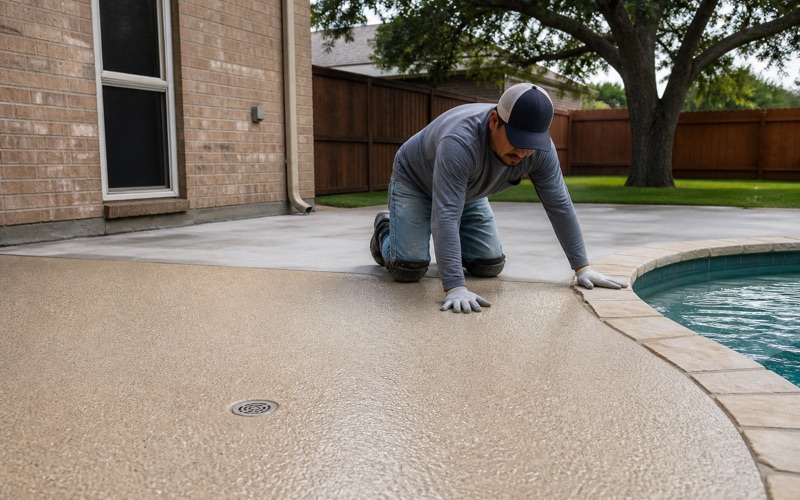
Where it does bite is on exterior resurfacing, because a driveway, a patio or a pool deck is worked outdoors and those surfaces have their own reasons to be done outside the hottest part of the day. Squeezing that into daylight rather than extending into the evening is a scheduling constraint we would rather name at the estimate.
It also affects how many days a job takes. An exterior coating that could run long in another city has to be broken into daylight sessions here, and each session carries its own edge and recoat considerations, which we price rather than absorb.
Looking for epoxy-flooring closer to Lakeway? See Lakeway Epoxy-Flooring.
Registering Before a Permit Can Exist
A Gate That Runs Before the Permit, Not After
Every contractor and subcontractor must register with the city before receiving a building permit. Registration costs $50, takes one to three business days, and requires a driver’s license, a W-9 and a certificate of liability insurance naming the City of Bee Cave.
So a contractor’s first job in this city carries a lead time that later jobs do not. It is a small thing that becomes a large thing on a project where the floor is the last trade in and the date has already been promised to somebody.
It Is Registration, Not a License
It is worth being precise about what that registration is. It is an administrative registration with the city, not a trade license, because Texas licenses no flooring, coatings, painting or general contractor at all.
Any company describing a city registration as a license is describing something that does not exist. What we can genuinely produce is general liability cover, workers compensation and a Texas sales and use tax permit, which are checkable claims.
The insurance certificate is worth a note of its own, because this city requires it to name the city itself. That is a document request to an insurer rather than something a contractor has sitting in a folder, which is another reason the registration is not a same-day step.
What the City Says About Permits, and About Deed Restrictions
Interior Painting Is on the No-Permit List
The city publishes a no-permit list, and it expressly includes residential and commercial interior painting and residential exterior painting alongside minor landscape work. That is unusually clear for a municipal publication, and we are not going to sell you a permit the city has already said is unnecessary.
The permit-required list is equally specific in the other direction. It includes finishing a garage to make additional living area, which is a genuinely different project from coating the floor of a garage that stays a garage.
So for the ordinary job we do here there is generally nothing to apply for, and we will say that plainly rather than implying complexity that earns nobody anything. Where a project genuinely does cross into permitted work, the registration above has to be in place first.
The City Points You at Your Association
Here is the part we appreciate about how this city communicates. It instructs residents to contact their homeowners association for deed restrictions that may apply even when no city permit is required, and points at the county clerk for the recorded copy.
That is honest advice and it is the right advice. A city permit and a private deed restriction are separate systems, and the absence of one says nothing at all about the other, particularly for visible exterior work such as a driveway coating.
The Code Editions Actually Adopted
One trap worth naming. This city’s adopted codes are the 2015 International series with the 2017 National Electrical Code, and the fire code is the 2015 edition with amendments. The city lists no International Residential Code edition at all.
The modern housing stock invites the wrong assumption here, because a city built almost entirely since 1990 looks like it ought to be on a recent code cycle. On commercial work we read the adopted edition off the city rather than inferring it from the buildings.
That matters most on the retail and office stock. The lifestyle center in this city holds a large amount of retail alongside Class A office space, and its back-of-house areas, tire and automotive bays and equipment rooms are exactly the kind of floors that carry a fire-code or specification touchpoint.
Slurry and Wash Water Over the Contributing Zone
A Regulated Water-Quality Matter
The city’s internal point sits inside the Edwards Aquifer Contributing Zone, where regulated activities fall under the state’s rules for that zone. For a grinding and coating trade that makes containment of slurry, wash water and rinsate a regulated water-quality matter rather than a courtesy.
There is a second constraint alongside it. No sewer certificate covers the internal point and the city lists on-site sewage facility rules among the codes it follows, so some parcels here are on septic, which further limits where any liquid from a job can go.
How We Actually Work
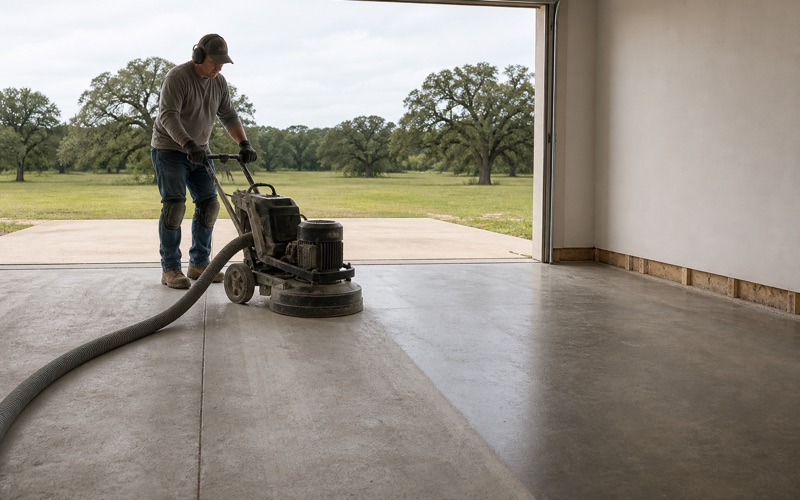
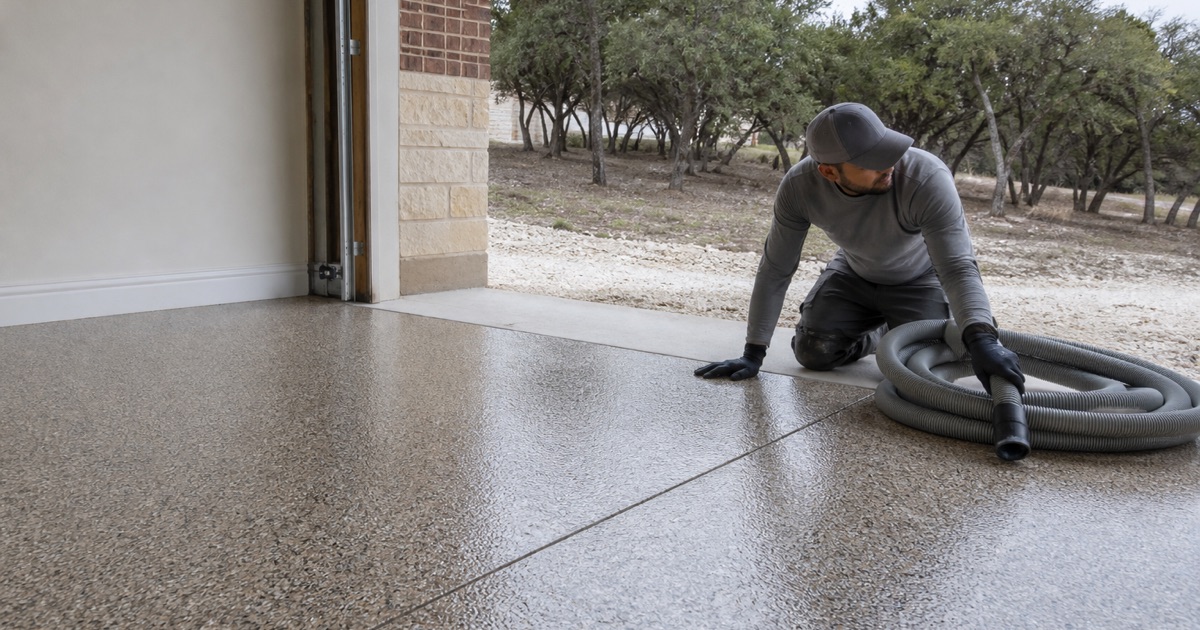
Grinding runs with vacuum-shrouded equipment and HEPA-rated extraction, so the byproduct is a bagged dust rather than a slurry and the disposal question largely disappears at source. Any wash water or solvent rinse is contained and removed from site rather than dealt with in a storm drain or a landscape bed.
We identify where water would go if it escaped before the equipment comes off the truck, and bund the low side of the work area. On sloping ground that planning is the difference between a contained job and a contaminated one.
The Ground, and the Slabs on It
USDA rates most of this city’s mapped area very limited for small commercial buildings, and the features it cites are slope, which reaches 85.6 percent of the area, and shrink-swell, which reaches only 15.9 percent. This is not a shrink-swell city, and the hub’s Blackland clay argument does not describe it.
Only five housing units in the entire city predate 1980, with roughly 96.4 percent of the stock built in 1990 or later. So the preparation question here is a builder finish rather than a coating history: a hard, closed, power-troweled surface, often still carrying a curing compound, which has to be opened mechanically to a proper profile. We do not acid etch and we never coat over an existing sealer, and moisture testing goes in as a priced line item whatever the age of the slab.
Just over half of the occupied housing here is rented, and those renters are overwhelmingly in multifamily structures rather than in houses, while almost every owner-occupied unit is a detached house. So the residential work divides cleanly into homeowners buying a garage floor and property management buying breezeways, stair landings and parking decks against a capital reserve plan.
- 20+ Years in Central Texas
- Insured & Workers Comp Covered
- Free Written Estimates