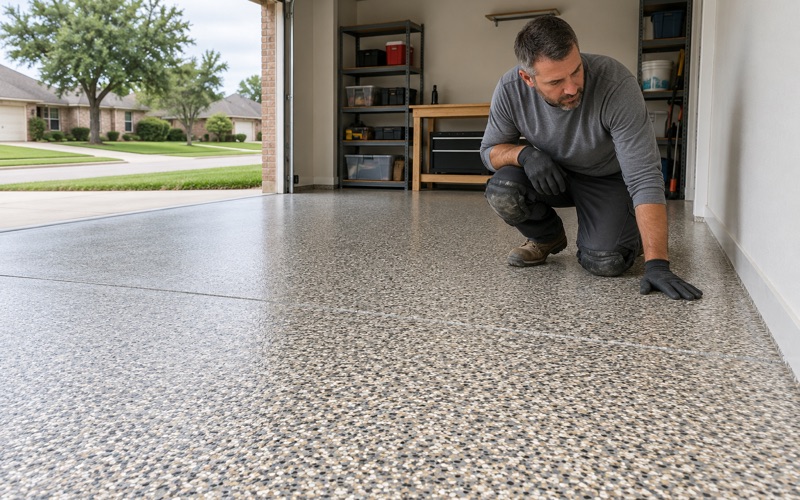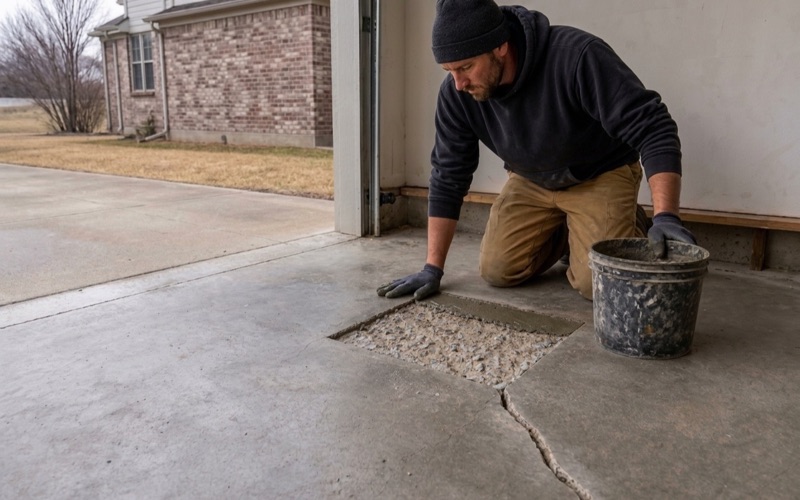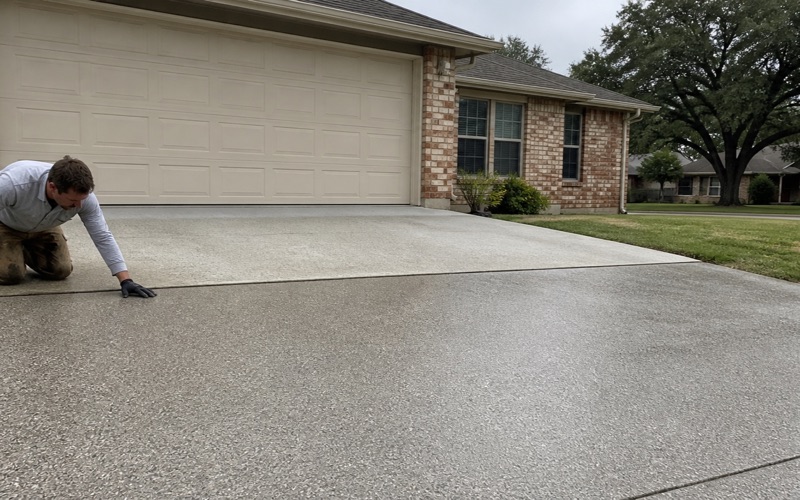
Pflugerville Epoxy Flooring installs epoxy flooring in Buda, and there is a genuine commercial argument to make about this city that does not apply anywhere else on our list. The cheapest coated square foot in this whole service area is a bare shell slab in a Buda tilt-wall building before its first tenant moves in.
We have been coating concrete across Central Texas for more than 20 years, and almost everything we do is retrofit work on floors that have been in use. Here there is a real pipeline of new construction, which means slabs that have never carried a rack, a forklift or a spill, and coating one before fit-out is materially cheaper than coating it afterward.
Buda is also the one city on our list in Hays County rather than Travis or Williamson, and that changes the permitting and food-permit stack completely. A specification written for an Austin job does not carry across the county line, and neither does a health-permit assumption.
Coating a Shell Slab Before the Racking Goes In
The Industrial Pipeline Here
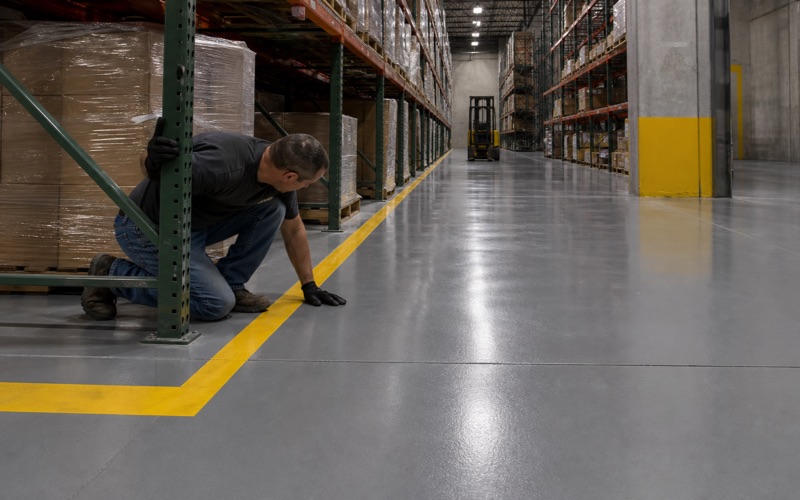
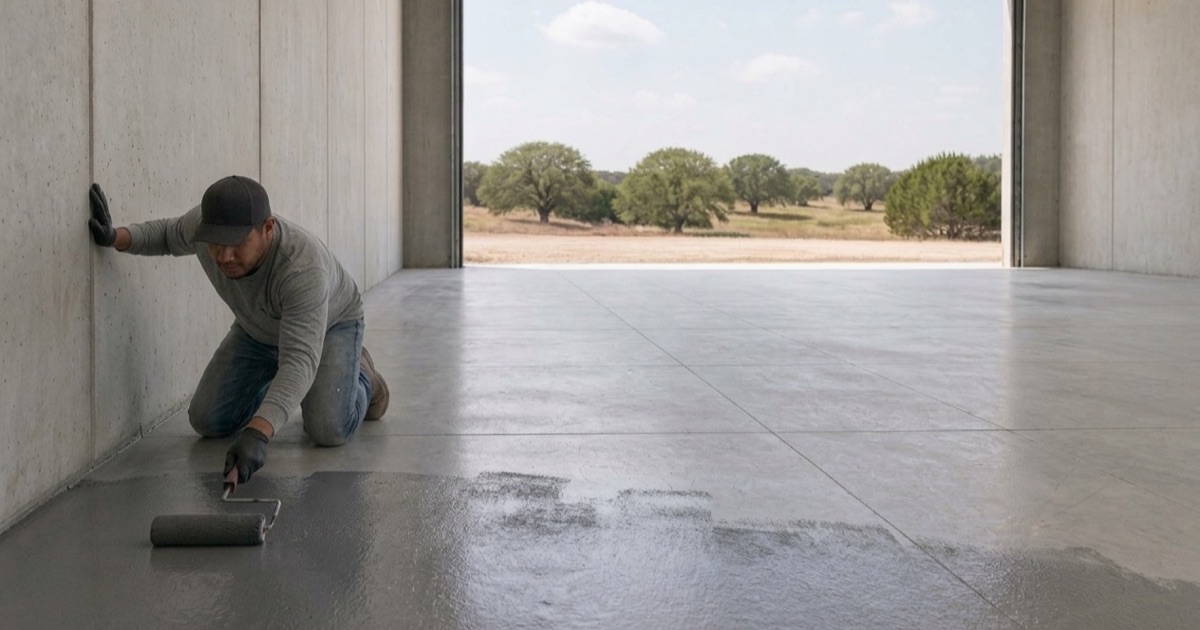
Buda Midway runs to more than 850,000 square feet across seven buildings, and Buda Commerce Center to close to a million square feet across five, both on Interstate 35 frontage. That is new construction rather than retrofit inventory, and it is a substantial amount of bare concrete.
A shell slab before fit-out is the easiest floor in this trade to coat well. It is empty, it is clean, there is nothing to work around, and there is no operation to phase the work against. Equipment can be brought straight in, a whole bay can be placed in one continuous pass, and nobody is waiting to get back into the space.
Why It Is Cheaper Before the Tenant
Every cost that makes an occupied industrial floor expensive is absent on a shell. There is no racking to dismantle and reinstall, no phasing that carries an extra edge and cure window per section, no working around trading hours, and no containment against an operating business next door.
There is also no contamination to remove. An occupied warehouse floor accumulates oil, tire rubber, spilled product and joint damage, all of which is preparation work, and a shell slab has none of it.
The difference between those two jobs on the same square footage is substantial, and it is worth raising with a developer or a tenant while a building is still empty rather than after the first lease starts. Once racking is anchored, the arithmetic changes permanently.
What Still Has to Happen
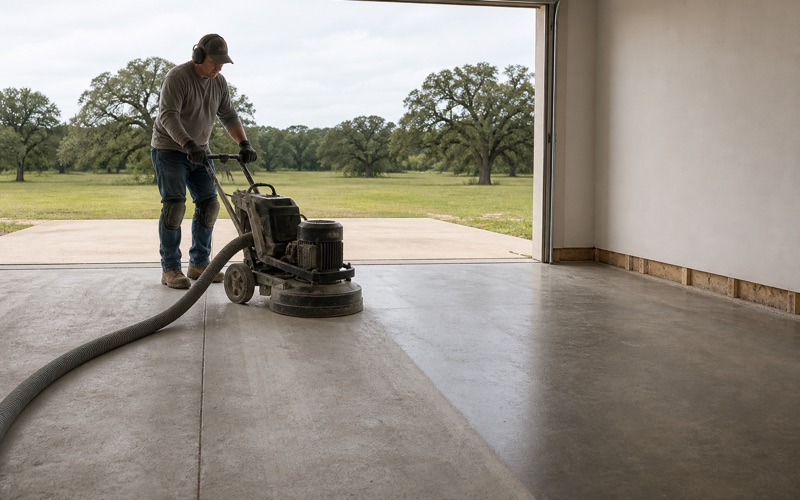
The slab is still opened mechanically to a proper profile, because a new tilt-wall floor is power-troweled hard and closed and frequently still carries a curing compound. We use ride-on shot blasters for open areas and diamond grinders for edges, corners and around columns, and we do not acid etch.
Joints are the other item, and on an industrial floor they matter more than the field does. We fill them with a semi-rigid polyurea that supports both edges under load, because a hard wheel crossing an unsupported joint edge chips it and the damage compounds with every pass.
Looking for epoxy-flooring closer to Wells Branch? See Epoxy-Flooring in Wells Branch.
Two Buda Floors Twenty Years Apart
A Recent Pour and a Twenty-Year-Old Box
The other half of the commercial work here is the opposite case. A large retail box that opened in 2005 at 185,000 square feet on Interstate 35 frontage is now a fit-out approaching twenty years old, and that is a recoat conversation rather than a new-slab one.
Those two jobs sit in the same city and need different scopes. One is a clean slab and a specification; the other is a diagnosis, a removal allowance and a phasing plan around an operating store. We price them very differently, and a quote that treats them as the same job per square foot is wrong on at least one of them.
What a Twenty-Year Fit-Out Has Accumulated
A retail or distribution floor of that age has wheel-path wear, joint edge damage, patched trenches from equipment and service changes, and whatever the operation spills. The existing floor treatment may be a coating, a sealer, a polished surface or bare concrete, and each behaves differently under tooling.
We test adhesion in a small area and take a section down to concrete before writing a number, so the removal allowance in the proposal reflects what the tooling actually did rather than an optimistic assumption about what will come off easily.
Delivery and Distribution Floors
There is also a delivery station operation here, and that floor type has its own constraint. It takes cart, pallet jack and forklift traffic on a schedule that never fully stops, which limits when a coating can be placed and cured.
Fast-cure polyaspartic and polyurea systems earn their cost in that situation, because return-to-service time rather than material price is what actually governs. We quote both approaches when either would suit the floor, with the system build and the cure schedule written out for each.
Phasing is the other lever on a floor that cannot stop. We split the work at joints or saw lines so each section stands on its own and match the seams into the layout, and we price the extra edge preparation and cure windows that phasing carries rather than absorbing them and rushing.
Hays County, Not Travis
Where a Food Permit Actually Comes From
The health authority for a commercial kitchen in Buda is Hays County Development Services. It is not the city building counter and it is not the Austin health department, and that is a distinction that costs a restaurant real time when it is got wrong.
Hays County permits food establishments in unincorporated parts of the county and in the cities it serves, and it inspects a permitted establishment on its own schedule. A floor specification for a kitchen answers to the food code as adopted by Texas, through that county process, rather than to a building department alone.
Mobile Food Permits Are Changing
One dated item worth knowing if a food truck floor is in scope. Texas moves to a statewide mobile food unit license effective July 1, 2026, and Hays County mobile food permits expire June 30, 2026.
That is a live transition rather than a settled position, and anyone planning work around a mobile unit should check the current arrangement rather than relying on how it worked previously.
An Adopted Code That Is Not Austin’s
The city runs its own development services on the 2024 International series plus the 2023 National Electrical Code, using the International plumbing and mechanical codes rather than the Uniform ones, through an online portal.
That last detail is the one that catches out specifications carried across from Austin, which uses the Uniform plumbing and mechanical codes instead. A document written for an Austin job does not simply transfer, and we read the applicable edition off the jurisdiction rather than off the region.
It is a small piece of diligence that avoids a resubmittal, and resubmittals are what actually cost time on commercial work. There is also no flooring or coatings license in Texas to hold, so what we show alongside the specification is general liability cover, workers compensation and a sales and use tax permit.
Water Service, Soil and the Residential Stock
A Provider That Changes by Address
Water service here is split three ways, between the city, a water supply corporation and a private utility. The provider is not predictable from an address, which matters on a commercial site where wash-down, floor drains and process water are part of the specification.
So we establish it rather than assume it. On a residential garage it rarely comes up; on a kitchen, a wash bay or any floor with a drain in it, knowing who the utility is belongs at the start of the conversation.
No Single Soil Answer
This city straddles the Balcones Escarpment, with roughly 62.9 percent of its mapped area in one major land resource area and 37.1 percent in the other, and Vertisols at about 46.5 percent against Mollisols near 44.8 percent. No single sentence about the substrate under this city is true.
So we establish which side of that boundary an address falls on before saying anything about crack detail. Where a crack is over reactive ground and still working, we route it and fill it with a semi-rigid polyurea as a moving joint and tell you before the job that it can telegraph through again.
The Residential Picture
Around 86.4 percent of the housing stock here postdates 2000, which makes a post-tension slab the default assumption on residential work rather than the exception. Nothing gets cored, drilled or saw-cut until the tendon layout is established, because severing a tendon is a structural repair rather than a floor repair.
The pre-1980 stock is small, at roughly 244 units or 3.9 percent, with about 63 units dating to 1939 or earlier around the historic Main Street core. That small layer is where conventionally reinforced slabs and detached garage forms are found, and it gets treated as the exception it is rather than folded into a citywide assumption.
- 20+ Years in Central Texas
- Insured & Workers Comp Covered
- Free Written Estimates