Pflugerville Epoxy Flooring installs epoxy flooring in Camp Swift, and the work here is genuinely different from a suburban garage. These are acre-scale lots with detached shop and barn slabs on them, poured over a sandy surface with a reactive clay layer buried underneath, which is a different failure geometry from clay that cracks open at the surface.
We have been coating concrete across Central Texas for more than 20 years, and most of that work sits inside city limits on platted lots. Out here the parcel is larger, the building is usually detached and unconditioned, nobody inspected the slab when it was poured, and the site services cannot be assumed to exist.
So this page is about the shop slab rather than the garage floor. It covers what is actually under it, why a buried clay lens behaves differently from surface-cracking clay, and the two site questions we settle before a grinder crew commits to a day out here.
A Shop Slab on an Acre Lot Is Not a Garage Floor
The Parcel Data
Of the appraisal-district parcels lying wholly inside this community, the median is about 0.619 acres, with roughly 804 parcels at one acre or larger and around 176 at five acres or larger. This is large-lot ranchette country rather than either tract suburb or working ranch.
Roughly a quarter of the parcels carry no improvement value at all, with about 693 of some 2,835 improvement-rated parcels showing none. Vacant land at that density is where a new shop building goes up, which is a real and continuing source of new slabs rather than a purely retrofit market.
What Changes About the Building Itself
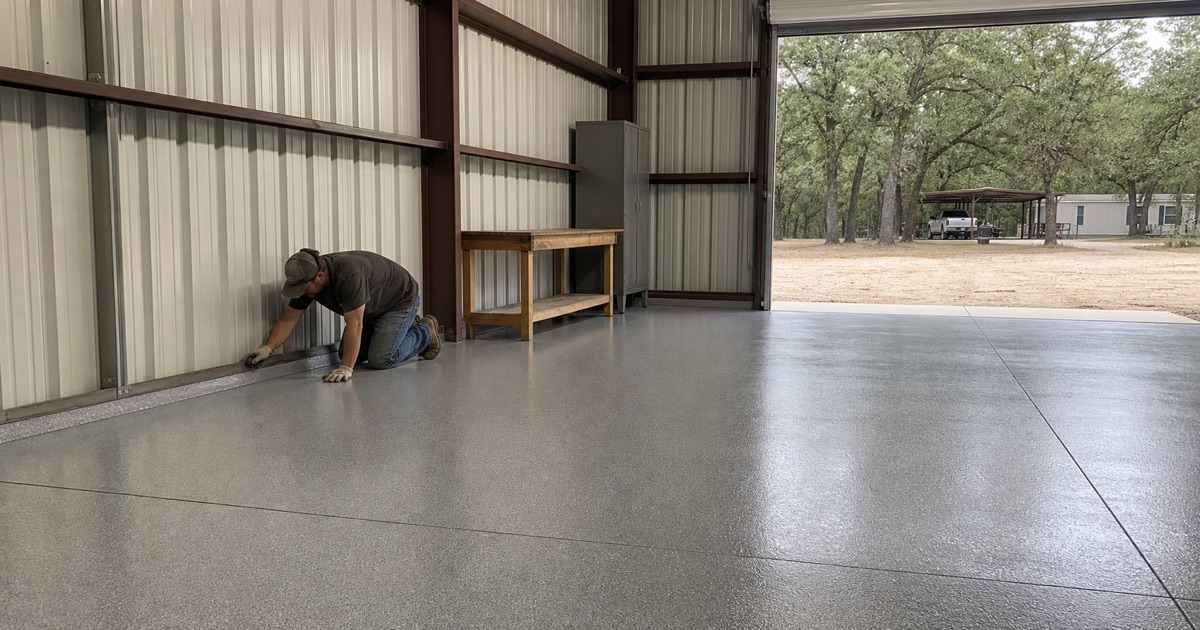
A detached shop or barn is a separate structure with its own footings, its own drainage and no house walls sheltering three sides of it. It is generally unconditioned, so it swings much further in temperature than an attached garage does, which affects when in the day a coating can go down.
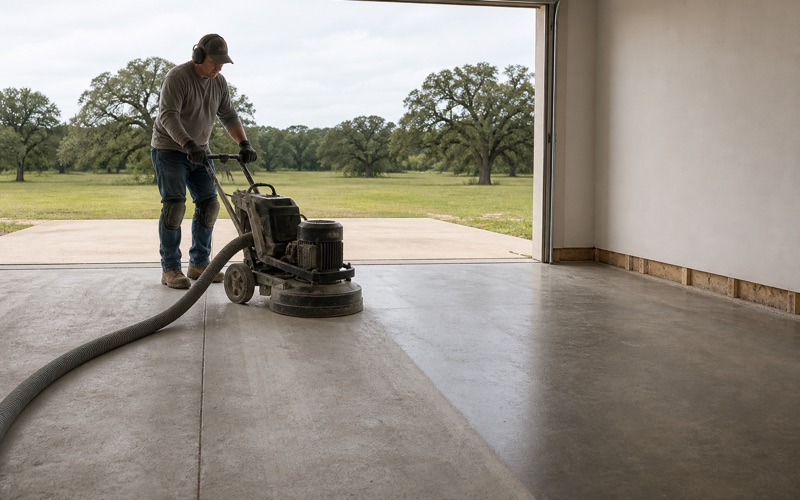
These slabs are also frequently rougher than house slabs, poured with less attention to flatness because nothing was ever going to be finished on top of them. That is entirely workable and it changes how much grinding is needed to reach a consistent profile, which we would rather establish by looking than by assuming.
Nobody Inspected It
A detached shop or garage here sits outside the county building code, and there is no county building permit or certificate of occupancy for it at all. Nobody inspected that slab when it was poured.
The honest consequence is that the contractor is the only quality control on the work. We treat that as a reason to hold the standard rather than to relax it, because the reason a floor lasts is a properly opened slab and a measured moisture reading, not an inspection that was never going to happen.
It also means the slab in front of us may have been poured to any standard at all, from a properly formed and reinforced pour to something laid in an afternoon. We sound it and look at it rather than assuming, and where the surface itself has failed we say that resurfacing comes before any coating.
Looking for epoxy-flooring closer to Manchaca? See Epoxy-Flooring in Manchaca.
Sand at the Surface, Reactive Clay Underneath
What USDA Actually Flags Here
This community is mapped about 91.8 percent inside the Texas Claypan Area rather than the Blackland Prairie, at roughly 94.8 percent Alfisols. That is a claypan soil rather than the deep cracking clay that the region is generally described as sitting on.
The sandy surface is not a claim of stability, and this is the reading that matters. USDA’s small commercial buildings interpretation flags shrink-swell as the limiting feature across around 70.4 percent of the mapped area here, so the reactivity is present even though the surface does not look like it.
Why a Buried Lens Fails Differently
On the hub’s ground, reactive clay is at the surface and it announces itself by opening visible cracks in the yard during a dry spell. Here the reactive material sits under a sandy horizon, so the surface stays intact and gives no warning at all.
That changes the geometry rather than removing the movement. Load is transferred through the surface layer to a lens that is swelling and shrinking below it, and the effect at the slab shows up as differential movement rather than as a crack pattern you can read off the ground beside the building.
What We Do About It
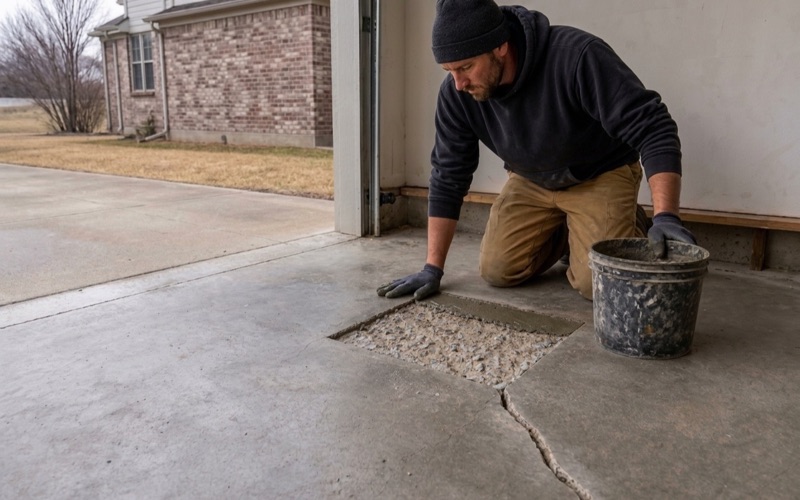
We read the cracks in the slab itself rather than the ground around it, separating a settled crack with worn, closed faces from one that is still opening and closing with the season. The two get completely different treatment and calling it wrong is what puts a line back through a new floor.
A crack over ground that is still working is routed and filled with a semi-rigid polyurea sized to move, and we tell you before the job that it can telegraph through again. A coating is a film a few thousandths of an inch thick that follows the slab, and nothing we install resists or absorbs ground movement.
A homeowner can also settle which soil their own address sits on rather than taking our word for it. The USDA Web Soil Survey takes a street address and returns the mapped series along with its shrink-swell interpretation, which is a far better basis for a conversation than anything a contractor asserts about a region.
A Hose Bib and a 240-Volt Circuit, Confirmed First
Two Questions Before the Grinder Is Loaded
On a rural site these are not formalities. Grinding equipment draws real current and cleanup needs water, and a detached shop at the back of an acre lot may have neither. A job site here can be on corporation water and its own septic with no municipal service at all.
So we confirm a hose bib and a suitable circuit before a crew commits to a day out here. Equipment that cannot be run is equipment that made the trip for nothing, and that cost lands on somebody either way.
Power in Particular
An outbuilding may have its own meter and panel, a subpanel fed from the house, or a single circuit run out for lighting and a door opener. Those are very different answers for a shot blaster or a large grinder, and none of them is visible from the driveway.
Where the supply is genuinely limited we can work with smaller equipment and more hours, or arrange a generator, and both of those are decisions to price at the estimate rather than discoveries to make on the morning.
Water matters for the same reason. Containment, cleanup and mixing all need it, and hauling it in is possible but adds time and cost, so it belongs in the quote rather than in a conversation halfway through the day.
Distance, Time and Honest Pricing
Commute patterns here are long, with roughly half of the workers travelling 30 minutes or more each way and a substantial group travelling an hour or more, which shapes when anyone is actually home. We schedule estimates around that rather than around our own convenience.
Price sensitivity is also a real feature of this market rather than something to talk around, with median household income and median home value both sitting well below the state figures. We quote a system that suits the building and the budget rather than the most expensive one that would technically work, and we say what each option gives up.
The Name on the Mail and the Name on the Map
Nobody’s Mail Says Camp Swift
Of the parcels inside this community that carry a situs city in the appraisal roll, essentially all of them read Bastrop and none read Camp Swift. The community name and the mailing address simply do not match, which is unusual even by the standards of unincorporated Texas.
The named subdivisions are what residents actually use: Lake Bastrop Acres is much the largest at around 1,396 parcels, followed by Lake Bastrop Estates, Lake Bastrop Club, Holiday Hills, Sanders Estates and several smaller ones. If you tell us the subdivision, we know where you are.
We ask for it on the first call for that reason. A street address alone in this community frequently returns something unhelpful, while a subdivision name and a lot size tell us the likely parcel scale, the likely building type and roughly how far off the highway a crew will be working.
There Is No City Here
This is an unincorporated census-designated place with no city government and no municipal building official. There is no city permit for a floor coating and no city inspector to schedule, and the county’s remit runs to development, septic permitting and floodplain rather than a building code over an outbuilding.
We confirm which authority actually reaches a given job before the first visit rather than reading anything off an address, which in this community would be actively misleading rather than merely unreliable.
What We Show Instead of a License
Ask a coatings contractor in Texas for a license number and the honest answer is that none exists. The state registers no flooring, coatings, painting or general contracting trade, and nothing in Bastrop County or in the districts covering this community adds a local one on top. A number offered here is a number somebody made up.
What we produce is general liability cover, workers compensation and a Texas sales and use tax permit, sent before the job rather than on request. The proposal names the product, the coat-by-coat system build and the finished mil thickness, so what was quoted can be checked against what actually went down on your slab.
- 20+ Years in Central Texas
- Insured & Workers Comp Covered
- Free Written Estimates