Pflugerville Epoxy Flooring installs epoxy flooring in Cedar Creek, and we are going to open with a subtraction rather than a sales figure. More owner households here live in a manufactured home than in a house, so the honest count of coatable residential floors in this community is around 396, and every claim about this market has to start there.
We have been coating concrete across Central Texas for more than 20 years, and a contractor page about a small community usually inflates it by quoting a population figure and letting the reader assume every household is a prospect. That is not true anywhere and it is dramatically untrue here.
What this community does have is a genuinely useful non-residential floor stock, in the form of three school campuses, and those buildings own more distinct coated-floor types than most commercial properties do. This page covers both halves honestly.
Counting the Floors That Exist
The Housing Mix
Of roughly 1,010 housing units in this community, about 614 are mobile homes, which is 60.8 percent. Of the 924 owner households, around 528 live in a manufactured home against about 396 in an owner-occupied detached house.
That is a majority-manufactured community, and it is worth saying plainly rather than working around. A manufactured home has no poured slab and no attached garage, so those units sit outside this market entirely rather than inside it.
The district appraisal roll corroborates the pattern at a wider scale, with several thousand mobile home accounts recorded across the emergency services district this community sits in. We mention it only as corroboration, because a district-scale figure describes a much larger area than this place and must not be read as a count of it.
The Number, With Its Margin
So the addressable owner-occupied detached pool here is about 396 houses, and it should be read with a margin of roughly plus or minus 165. The population estimate carries a margin of about 26 percent, which is normal for a place this size rather than a defect in the data.
We quote it as a shape rather than a count. Nothing about how we plan work depends on the figure being exact, and stating the uncertainty is more useful than a precise-sounding number the underlying survey does not support.
Every Detached House Is Owner-Occupied
One unusual reading worth mentioning. Every detached house in this community is owner-occupied, with renter-occupied detached houses recorded at zero, and around 91.5 percent of occupied units overall are owner-occupied.
That means the person we are talking to about a garage floor is the person who owns it, without exception in the recorded data. There is no landlord layer and no property management layer at all, which makes decisions quick and scheduling straightforward. It also means every quote is a conversation with somebody who will live with the result, which tends to produce better decisions about finish and durability than a specification written for a turnover schedule.
Looking for epoxy-flooring closer to Bastrop? See Bastrop Epoxy-Flooring.
What a Manufactured Home Has Instead
Not a Garage Slab, But Often a Slab
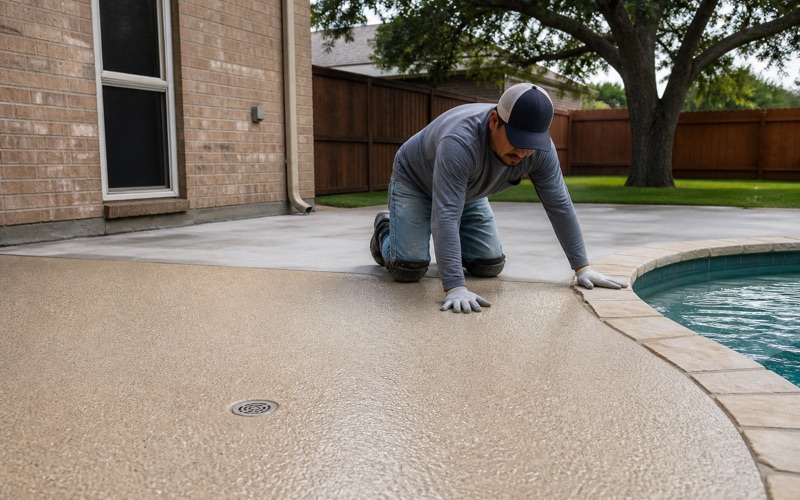
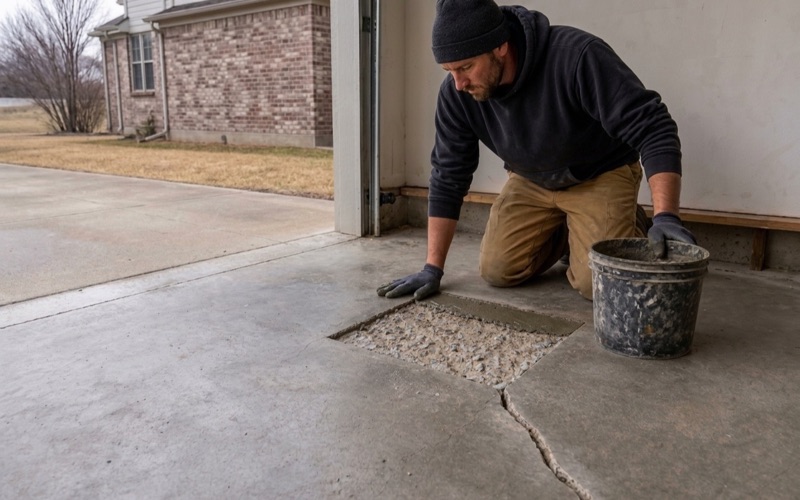
The subtraction above does not mean there is nothing to do at those properties. A manufactured home frequently sits alongside a poured pad, a carport slab, a patio or a detached workshop, and those are floors we can coat perfectly well.
So the honest framing is that the dwelling is not part of this conversation and the property may well be. We ask what is actually on the lot rather than assuming from the housing type, because a database category tells you about a house and not about the concrete beside it.
What Those Slabs Are Usually Like
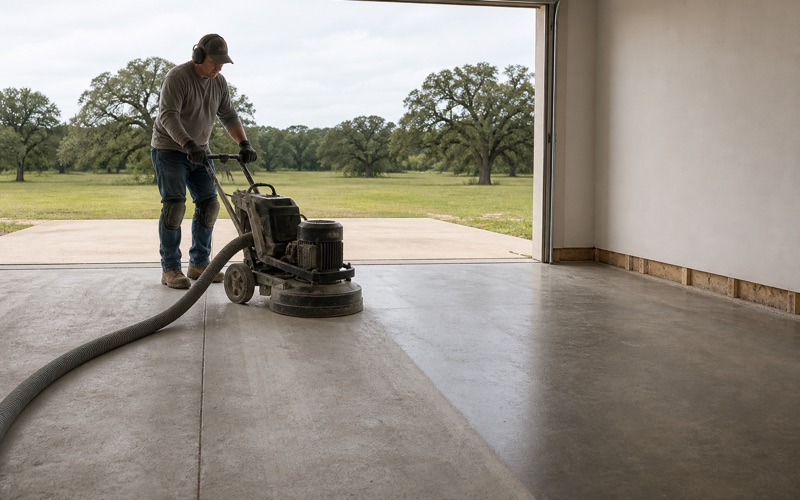
Pads and carport slabs of that kind are typically poured with less attention to flatness than a house slab, because nothing was ever going to be finished on top of them. That is workable, and it changes how much grinding is needed to reach a consistent profile across the area.
They are also generally uncovered or only partly covered, which puts ultraviolet exposure into the specification. Epoxy is not ultraviolet stable and ambers under sun, so anything open to daylight is finished with a polyaspartic or polyurea topcoat that holds its color.
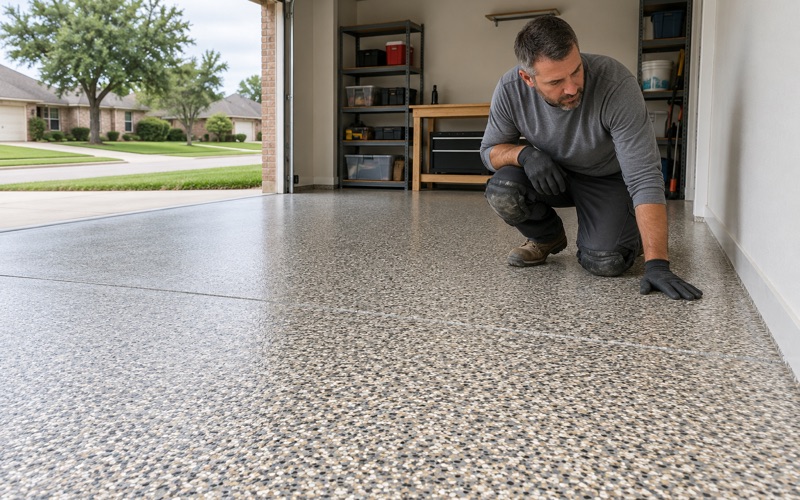
Traction matters more on those surfaces too. A pad or a carport slab gets rained on, so slip resistance is built into the system as a broadcast aggregate sized to grip a wet shoe rather than left to a sealer to provide.
Nobody Inspected Any of It
There is no building permit, no building code and no certificate of occupancy over any structure here that is not a single-family house or duplex. A detached workshop, equipment barn, RV barn or shop slab sits outside every building-code regime that exists.
The practical consequence is that the contractor is the only quality control on the work. We sound the slab, look at what is on it and measure moisture rather than assuming, because the reason a floor lasts is preparation and testing, not an inspection that was never scheduled.
Three School Campuses and the Floors They Own
The Non-Residential Stock Here
Three Bastrop Independent School District campuses sit inside this community: Cedar Creek Elementary School, Cedar Creek Middle School and Creekside Middle School. That is the substantive non-residential floor stock here.
We are careful about what else we claim, because several well-known places carry a Cedar Creek mailing address and sit outside this community’s boundary entirely. Naming them would be borrowing an anchor rather than describing this place, and we would rather report the roster honestly and short than pad it with landmarks that sit somewhere else. It is also the sort of error a local reader spots immediately, which makes it worse than useless.
A Campus Owns Almost Every Floor Type
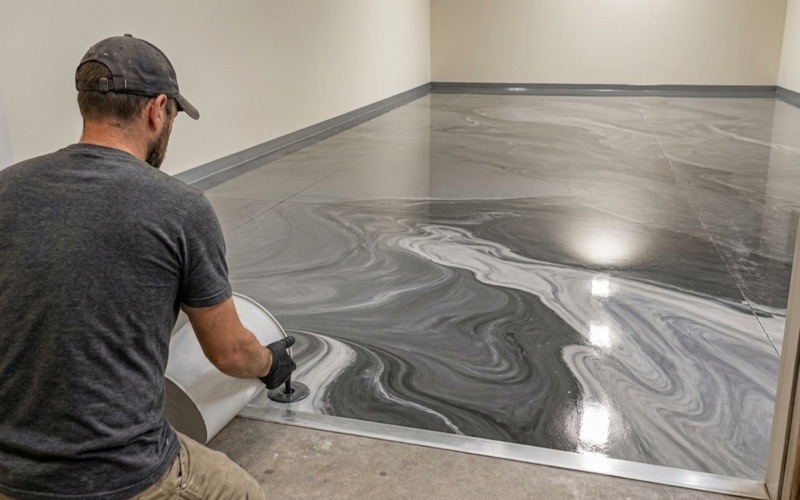
A school building is the richest set of coated-floor conditions we encounter outside of industry. A cafeteria and kitchen need a food-service specification with an integral coved base at wall junctures and a surface built to the health code’s smooth, durable and easily cleanable requirement.
Then there is a gymnasium, locker rooms, corridors and restrooms, each with its own wear, slip resistance and cleanability requirements, plus maintenance and bus facilities that are chemical-resistance and heavy-traffic problems instead. That is four or five genuinely different specifications inside one property line.
Why We Quote Them Separately
We price and specify those areas individually rather than applying one system across a campus. A corridor and a bus maintenance bay have almost nothing in common beyond being concrete, and writing them as a single line item is how a specification ends up wrong in both places at once.
Submittal documentation comes with it: product data sheets, safety data sheets, the coat-by-coat system build, the finished mil thickness and the cure and return-to-service schedule. On institutional work that package is expected up front rather than produced at the end.
The same discipline serves a homeowner. Our proposal names the product, the coat-by-coat system build and the finished mil thickness, which is what makes two quotes comparable and lets the finished floor be checked against what was actually bought rather than taken on trust.
How a District Buys a Floor, and When
Procurement Runs on Its Own Calendar
A school district does not buy a floor the way a homeowner does. There is a purchasing process, a specification written before anyone quotes, and an approval path that has nothing to do with how quickly a contractor can mobilize.
We plan around that rather than pushing against it. Getting the floor specification in front of the right people early is worth far more than being available at short notice, because availability is rarely the constraint on this kind of work.
The Building Has to Be Empty
Campus floors are bought on shutdown windows, and those dates do not move for a contractor. Academic breaks are fixed, published and long-lead, which is the opposite of a residential garage’s flexible weekend.
That means the work has to fit inside a known number of days including cure time, and it means phasing so that areas return to service in the order the building needs them. Fast-cure polyaspartic systems earn their cost here, because a day saved on return-to-service can be the difference between a break that works and one that does not.
Distance, Density and What We Charge For
This community covers about 18.0 square miles with roughly 1,010 housing units in it, which works out near 56 dwellings per square mile. That is a driveway-served settlement pattern rather than a platted grid, and there is no cluster of jobs to route around.
Drive time is therefore a genuine cost rather than a rounding error, and we say so at the estimate instead of adding travel to an invoice later. Where neighbors want work done at the same time, doing so genuinely reduces the cost for both of them, and it is worth a conversation over a fence before either of you calls anybody. As everywhere in Texas there is no flooring or coatings license to hold, so what we show is general liability cover, workers compensation and a sales and use tax permit.
- 20+ Years in Central Texas
- Insured & Workers Comp Covered
- Free Written Estimates