Pflugerville Epoxy Flooring installs epoxy flooring in Cedar Park, and this is the one city we work in where the question of where the rinse water goes is answered in the criminal code rather than in a best-practice guide. That is not a figure of speech, and it changes how we set up a job here.
We have been grinding and coating concrete across Central Texas for more than 20 years. The coatings we install in Cedar Park are the same ones we install anywhere, and the containment discipline around them is not, because this city has mapped cave preserves inside its limits and an ordinance that reaches directly at the materials our trade uses.
This page explains that rule and what it means in practice, where the preserves actually are, and how the aquifer permitting question really works, including the part most contractors get backwards. It also covers why a mailing address settles nothing about jurisdiction here, with the city’s own largest employer as the worked example.
The One Rule Here That Reaches a Bucket of Rinse Water
What the Cave Preserve Ordinance Actually Says
Cedar Park Code section 8.03.006 makes it unlawful to introduce chemicals, sewage, petroleum products or pesticides into caves or critical habitat areas inside a cave preserve. It also prohibits dumping trash and junk. That is unusually direct language for a municipal code, and it names the exact categories of material a coatings crew arrives with.
The penalty is not administrative. The ordinance warns that persons depositing foreign material or committing vandalism harming federally protected species within cave preserves may be criminally prosecuted, with punishment up to one year in prison and fines up to $25,000 per offense.
Grinder Slurry, Wash Water and Solvent Rinse
For the purposes of that ordinance, the byproducts of our work are foreign material. Wet grinding produces a slurry of cement fines and water. Cleaning tools and rollers produces solvent rinse. A pressure wash of a driveway before coating produces runoff carrying whatever was on the concrete.
None of those may be tipped, hosed or allowed to run into a preserve, and near one that means containment is a legal requirement rather than a courtesy. We collect slurry at the tool, contain wash water, and remove rinse and waste from site rather than dealing with it in a storm drain or a landscape bed.
How That Works on an Actual Driveway
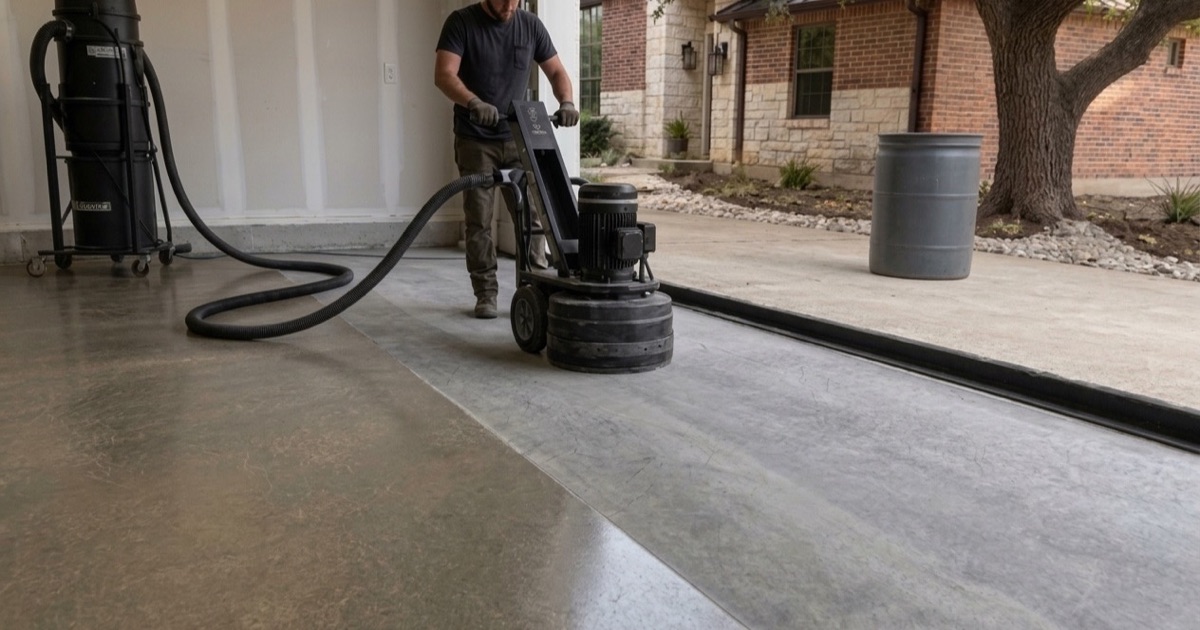
In practice it means planning the setup before the equipment comes off the truck. We identify where water would go if it escaped, berm or bund the low side, keep vacuum extraction on the grinder rather than relying on a wet method, and bring containers for anything liquid that has to leave.
It is not difficult work and it is easy to get wrong through inattention. A crew that has never been told about the ordinance will do what crews do everywhere else, which is exactly the behavior the ordinance was written to stop.
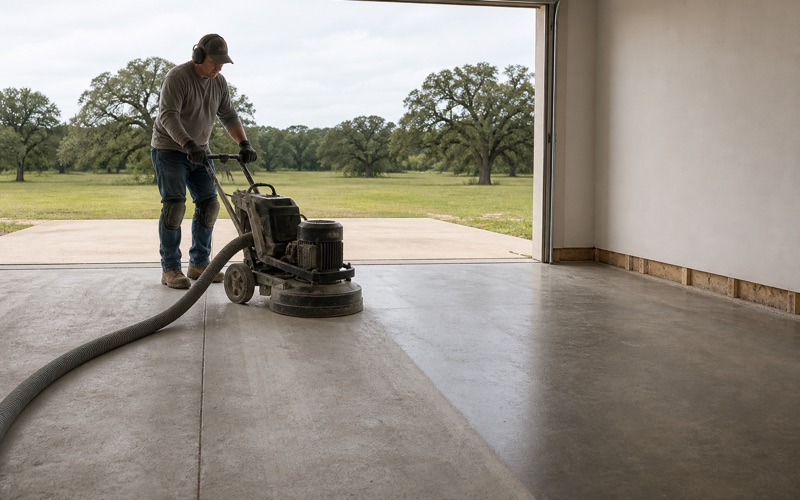
Dry methods help more than anything else. Grinding with vacuum-shrouded equipment and HEPA-rated extraction produces a bagged dust rather than a liquid, which removes the disposal question at source instead of managing it afterward.
Looking for epoxy garage floor closer to Austin? See Epoxy Garage Floor Services in Austin.
Where the Preserves Are, and How Large They Are
Mapped Land, Not an Abstraction
The city’s Parks and Recreation department manages more than 1,000 acres of parkland, 46 parks and 34 miles of trail, and among that it manages cave preserves as a distinct category. The Buttercup Creek Cave Preserves cover 113.5 acres, classified as a Natural Area, and the Discovery Well Cave Preserve covers 108 acres.
These are real, sizable, mapped parcels rather than a notional environmental overlay. That is useful, because it means the question of whether a job is near one has a definite answer that can be checked before a crew is scheduled.
An Acreage the City Itself Reports Two Ways
Worth flagging honestly: the city’s own documents carry two different totals for cave-preserve acreage, 250 acres in one section and 291 acres in another, and they are not reconciled with each other. We report that rather than picking whichever suits.
The discrepancy does not change anything practical. Either figure describes a substantial amount of protected ground inside the city limits, and the operative question on any given job is proximity rather than total area.
What We Ask Before Booking
Where a property backs onto or adjoins preserve land, we say so at the estimate and describe the containment we will use. That belongs in the conversation early, because it affects setup time and occasionally the method we choose.
It is also worth saying that we apply the same containment standard on jobs nowhere near a preserve. The reason is straightforward: a crew that changes its habits by location will eventually get the location wrong.
None of this affects the floor you end up with. The preparation, the profile, the moisture testing and the system build are exactly what they would be anywhere else in our service area, and the containment discipline sits alongside them rather than in place of any of it.
The Aquifer Permit Question, Both Halves of It
What the Code Requires
Cedar Park Code section 12.16.002 requires review by the Texas Commission on Environmental Quality for major subdivision, development plat and site development plans located within the Edwards Aquifer contributing or recharge zones, and that approval is a precondition of a city site development permit.
The city’s own stormwater material states that the majority of the city sits in one of those two zones. An independent grid sample inside the city limits returned most points in the Contributing Zone, a small number in the Recharge Zone and a few in neither, which confirms the city’s statement and shows the split is uneven rather than uniform.
The Exemption Most Contractors Get Backwards
Here is the half that gets misstated, sometimes in a way that sells work. The same stormwater article exempts additions or modifications to existing single-family structures, and development or redevelopment creating no more than 1,000 square feet of additional or new impervious cover where it is not part of a larger common development plan.
A residential garage floor coating does not create new impervious cover and it is a modification to an existing single-family structure. It does not need Edwards Aquifer approval, and a contractor telling you it does has manufactured a permit that does not exist. We would rather lose an upsell than invent an approval.
Where a job genuinely is site development, such as a new commercial slab or an expansion adding meaningful impervious cover, the state review is real and it precedes the city permit. Knowing which side of that line a project sits on is worth establishing early, because the two paths have very different lead times.
Where the Code Is Deliberately Quiet
It is also worth noting what the code does not do. A full-text search of the Code of Ordinances returns no results at all for karst, and exactly one hit for the Edwards Aquifer, at the section above. The caves are regulated as preserves and the aquifer is deferred to the state.
So there is no standalone recharge-zone ordinance in this city to comply with. The obligations that genuinely reach our work are the preserve ordinance and the state review that applies to site development, and conflating the two produces confusion in both directions.
The Address on the Envelope Is Not the Jurisdiction
The City’s Own Largest Employer Proves It
The mailing address settles nothing here, and the clearest example is the biggest employer in the city. Firefly Aerospace publishes a Leander headquarters address, and a reverse geocode of that street segment returns Cedar Park. Meanwhile Lakeline Mall carries a Cedar Park postal address and sits inside the City of Austin.
The error runs in both directions, which is why we confirm the actual jurisdiction from a geocode rather than from an envelope before the first visit. On a commercial job that determines which building department, which fire authority and sometimes which county you are dealing with.
It is a five-minute check and it prevents an entire class of expensive mistakes. We do it on any job near a boundary rather than only when something about the address looks unusual, because the addresses that mislead rarely look unusual at all.
Two Counties, Two Appraisal Districts
Cedar Park sits primarily in Williamson County with a portion in Travis, and appraisal and tax collection are split between two districts and two tax offices. Which county a job falls in is a live question rather than a formality, and it changes the answer on several administrative points.
Outside the city limit on the Williamson County side, authority changes entirely. The county has adopted no residential building code for unincorporated areas and cannot issue a certificate of occupancy, while commercial, public and multi-family construction is permitted through the county fire marshal instead.
Fire Coverage in the Extraterritorial Areas
Fire jurisdiction outside the city is not uniform either. The city fire department serves several contract areas covering different unincorporated subdivisions under different emergency services districts, and neighboring districts cover others.
For a commercial coating job that changes an interior finish or introduces chemical storage, knowing which fire authority actually has the site is worth establishing at the quote. And in Texas none of this involves a trade license, because there is none for flooring or coatings work, so what we produce instead is insurance, workers compensation and a sales and use tax permit.
- 20+ Years in Central Texas
- Insured & Workers Comp Covered
- Free Written Estimates