Pflugerville Epoxy Flooring installs epoxy flooring in Elgin, and the first thing to understand about a floor here is that this is one town carrying two housing stocks with almost nothing between them. Which half of town your address sits in settles a great deal before anyone has looked at the concrete.
We have been coating slabs across Central Texas for more than 20 years, and Elgin is the clearest example in our whole service area of a place where an average describes almost nobody. The old core and the newer subdivisions were built under entirely different conventions, and a floor in one is a genuinely different job from a floor in the other.
This page sets out that split honestly, what each half means for preparation and testing, why the median year built is the least useful number anyone could quote you about this town, and the county line that runs straight through the city limits and catches out contractors who work from an address alone.
Two Elgins, and Which One Your Address Is In
A Stock That Is Genuinely Bimodal
Of roughly 4,493 housing units in this city, 40.0 percent were built before 1980 and 46.6 percent in 2000 or later. Those are the two peaks, and the trough between them is remarkable: only 158 units were built across the whole of the 1990s. That is not a gentle distribution with a middle, it is two separate waves of construction that happen to share a city limit.
The consequence for our trade is that the two halves must not be averaged. A quote written on a general impression of the town will be wrong for both, because there is very little housing that resembles the impression. We ask which part of town an address is in before we say anything about likely slab condition.
Why the Median Year Built Is Useless Here
The median year built for this city comes out around 1990, which sounds informative and is actively misleading. It falls squarely inside the decade in which almost nothing was built, so it describes a house that essentially does not exist here.
That is worth saying plainly because medians are what most quoting tools and most out-of-area contractors reach for. A number that sits in the gap between two populations is not a summary of either of them, and using it produces the wrong preparation allowance in both directions.
What We Ask Before Quoting
So the first questions are about the address rather than about the floor: which part of town, roughly what era, and what has been done to the slab since. That takes a minute on the phone and it changes what we bring, how long we allow and what the estimate says.
Where the answer is uncertain we look before we price. Guessing costs more than driving out, particularly on the older half of town where what is under a covering has frequently surprised the owner as well.
There is a real local-employment population here alongside a long-commuting one, with about one worker in eight travelling under ten minutes to work. That makes weekday estimates more workable in Elgin than in several of the commuter communities nearby, and we schedule accordingly rather than defaulting to evenings.
Looking for epoxy-flooring closer to Hornsby Bend? See Epoxy-Flooring in Hornsby Bend.
The Older Core, Where the Pour Predates the Rules
Nearly Five Hundred Slabs From Before 1950
Around 495 units in this city predate 1950 and roughly 741 predate 1960, with about 353 built in 1939 or earlier. Those are real numbers on real streets rather than a statistical tail, and they are what makes the old core of this town different from most of the suburban ring we work in.
A slab of that age was poured under conventions that no longer apply. There is no reason to expect a vapor retarder underneath it, thickness can vary across a single room, reinforcement may be absent, and there may be an added topping or a repair from work nobody now remembers.
What That Changes About Preparation
Surface hardness on an old slab varies more than on a modern pour, sometimes within one room, so diamond segment bond hardness has to be matched to the concrete rather than to a default. Soft bonds go on hard concrete and hard bonds on soft, and on a mixed floor that can mean changing tooling partway across.
There is also usually something on the slab. Mastic, thinset, layers of tile adhesive, old paint and penetrated oil all have to come off with the right tooling before anything bonds, and penetrated oil in particular has to be degreased and then mechanically removed down to sound material.
Testing Rather Than Assuming
Moisture testing goes into the scope as a priced line item on these floors rather than being sold afterward. On a slab poured before anyone put plastic under concrete, a measurement is the only way to know what is coming up through it, and the answer decides whether a mitigation primer is needed.
Cracks get read rather than counted. A settled crack with worn, closed faces is routed, filled rigid and ground flush, while one that is still working is detailed as a flexible joint with a semi-rigid polyurea and disclosed before the job as something that can show through again.
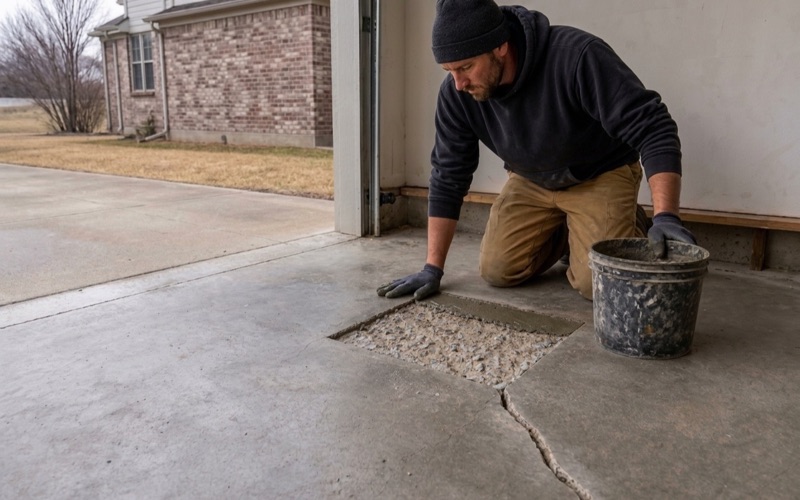
Where the surface itself has spalled or delaminated there is nothing sound to coat, and the honest answer is resurfacing before any system goes on. We sound the slab out before quoting so that appears as a priced item rather than as a discovery once a crew is already on site.
The Post-2000 Half, Where the Question Is Different
Newer Slabs, Different Unknowns
Roughly 2,095 units here date to 2000 or later, and on those the questions change entirely. The concrete is generally sound, the joints are laid out conventionally, and there is rarely anything on the surface except a curing compound or a builder’s sealer.
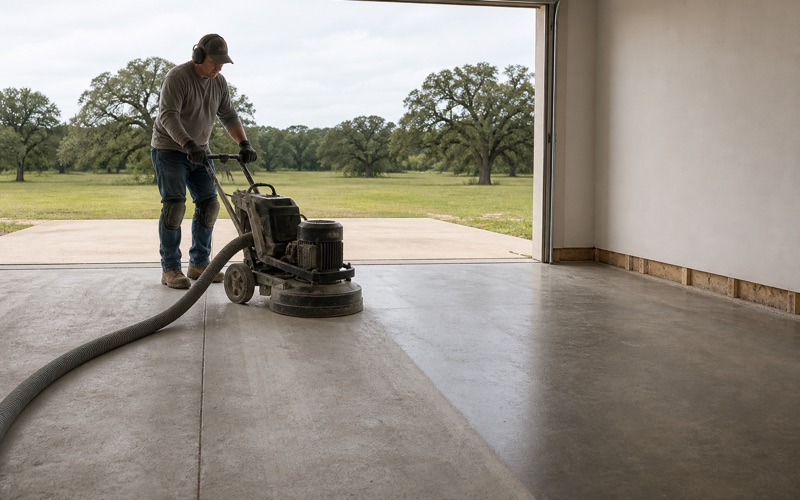
What replaces the old questions is a surface that is power-troweled hard and closed. That has to be opened up mechanically with a grinder or a shot blaster to a proper profile, because a coating laid onto a burnished surface bonds to a skin rather than to the concrete and lets go in sheets later.
Town Lots, Not Acreage
Inside the city limits this is a platted-lot town rather than acreage country. The median zoned parcel is around 0.240 acres and only about 11 percent reach a full acre, so the work available inside the limits is town-lot garages and small commercial floors.
The acreage shop and workshop market people associate with this area is in the surrounding unincorporated county rather than inside the city. That distinction matters for access and staging as well as for jurisdiction, because on a quarter-acre lot the driveway is both the route in and the whole working area.
Who Owns the Slab
Around 768 single-family detached units here are renter-occupied, which is roughly 21 percent of the occupied detached houses in the city. That is a meaningful share, and it means a fair number of garage inquiries come from someone who does not own the floor.
Rental work is bought on durability, cleanability and turnover rather than on appearance, and it has to fit a vacancy window that is usually short. We quote it on those terms instead of handing a landlord a homeowner’s proposal.
One local nuance worth knowing is that the most numerous residential zoning district in the city expressly permits mobile homes, and it is concentrated in one part of town. Those are small lots carrying a housing type with no slab and no attached garage at all, which is another reason a citywide count of homes overstates the addressable garage market here.
A City Limit That Crosses a County Line
One City, Two Counties
The county line runs through the middle of this city. A sample of interior points returns Bastrop County for most of them and Travis County for the rest, which means it is simply wrong to describe the whole city as being in one county.
Both sides are permitted by the same city building division, so for the building permit itself the county does not change the answer. For anything county-administered it does, and a job on one side of that line can sit with a different county office from a job a few streets away.
Inside the Limits Versus Outside Them
Inside the city limits the city is the permitting authority. Outside them the position is entirely different, because the county issues no building permits and no certificates of occupancy for that kind of work, and the review that does exist runs through a different route.
The trap is the mailing address. An Elgin address can sit outside the city limits altogether, as the local brick plant’s address does, and that is a completely different permitting picture from a job three miles closer in. We confirm the actual jurisdiction before the first visit rather than reading it off an envelope.
It is a short check and it prevents a whole category of expensive mistakes on commercial work, where the wrong assumption sends a submittal to a counter that was never going to review it. On a residential garage it matters less, and we still do it, because the addresses that mislead almost never look like they will.
What We Show Instead of a License
Texas licenses no flooring, coatings, painting or general contractor, and neither this city nor either county adds one. There is no license number for a floor coating to hold, and a company offering you one is offering something that does not exist.
What we can produce is general liability cover, workers compensation and a Texas sales and use tax permit, sent before the job rather than on request. Our proposal also names the product, the coat-by-coat system build and the finished mil thickness, so what was quoted can be checked against what actually went down.
That document does double duty. It is what a customer uses to compare two quotes on equal terms, since two proposals for an epoxy garage floor can differ by half the material and read almost identically, and it is what makes a finished floor auditable rather than something you simply have to trust.
- 20+ Years in Central Texas
- Insured & Workers Comp Covered
- Free Written Estimates