
Pflugerville Epoxy Flooring handles epoxy floor repair across Pflugerville, TX and the surrounding cities including Wells Branch, Round Rock, Manor, Hutto and Brushy Creek. More than 20 years in this trade means a good share of our work is looking at floors somebody else installed, and the first thing we do is work out why the floor failed rather than what it would cost to cover it up again.
That order matters more here than on any other page of this site. An epoxy floor that has let go is a symptom, and there are only a handful of causes: it was never bonded to the concrete, there is moisture coming up through the slab, the slab itself is moving, or the coating was built too thin for what it carries. Each one has a different fix, and applying the wrong one guarantees the same result a second time.
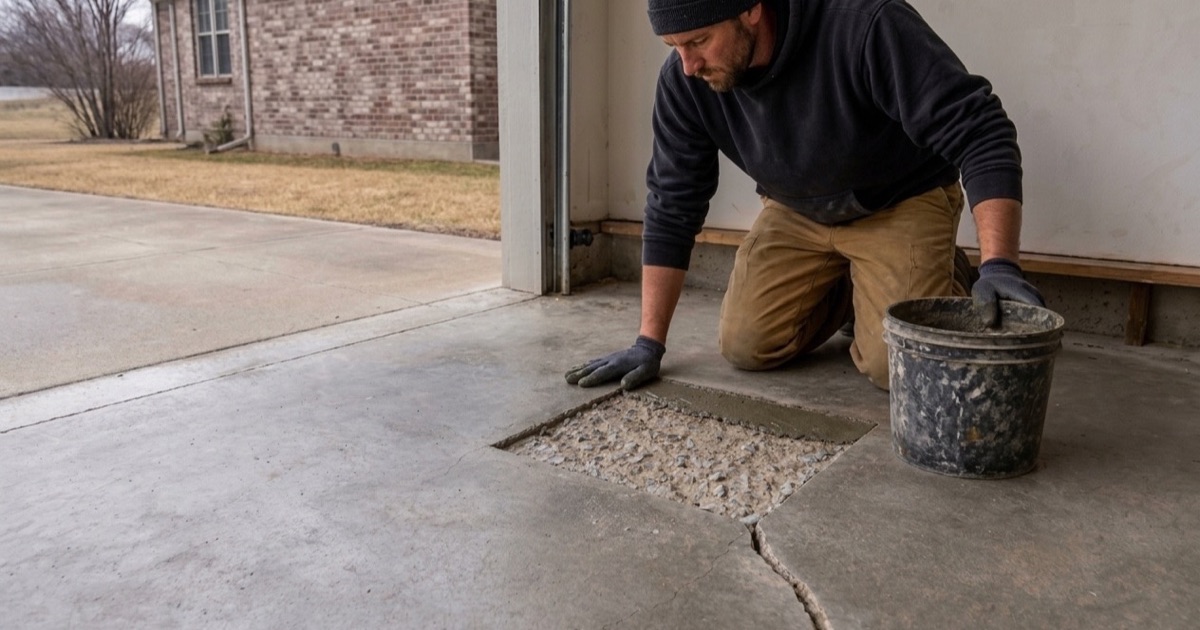
So we diagnose before we quote. That usually means cutting into a failed area to see the back face of the coating, sounding the slab, testing moisture on bare concrete, and looking at how the damage is distributed across the floor. It is an hour’s work that saves a repeat failure, and we would rather spend it than skip it.
Diagnosing Why the Floor Failed
Reading the Peel Pattern and the Back Face
How the coating separated tells us where the failure happened. A sheet lifting clean with a smooth, glassy underside never bonded to the concrete at all, which points to an unground, sealed or contaminated slab, while a film that brings a thin layer of concrete away with it means the bond was good and the slab surface itself was weak. A coating separating between its own layers points instead to a missed recoat window. Three different causes, three different repairs.
Blisters, Bubbles and Moisture From Below
A blistered floor is a moisture problem until proven otherwise. We cut a blister open and look for a damp or alkaline ring on the slab side, then test the bare concrete with ASTM F1869 calcium chloride or ASTM F2170 in-situ probes and read the result against ASTM F710 thresholds. Where the numbers are high, a moisture-mitigation primer goes into the repair scope, because reinstalling over an untested slab simply buys the same blisters again.
Hot Tire Pickup, Wear-Through and Thin Build
Where patches lift under the wheels of a parked car and nowhere else, the diagnosis is usually a coating that was too thin, not fully cured before use, or a thin one-part garage paint rather than a built system. Wear-through in traffic lanes points the same way. These floors are often perfectly bonded everywhere else, and the honest answer can be a full recoat over a properly abraded existing surface rather than a complete removal.
Repairs We Carry Out
Localized Removal and Rebuilding
Where the failure is confined and the rest of the floor is sound, we cut back to a firmly bonded edge, remove the failed material with PCD tooling or grinding, profile the exposed concrete, and rebuild the system in the same coats it was originally built in. Matching an aged floor is honest work with a limit: color and gloss on a floor that has weathered for years never match new material exactly, and we say so before starting.
Crack Repair and Joint Detail
Cracks that keep returning through successive floors are the most common repair we are called for, and they are a movement problem rather than a filling problem. We open the crack into a proper routed channel, fill it with a semi-rigid polyurea that flexes, and carry the coating over it, and where the movement is significant we detail a deliberate joint at the surface so the slab has somewhere to move. We also tell you before the work that it can telegraph again, because a film a few thousandths of an inch thick cannot stop a slab.
Full Removal and Reinstallation
When most of the floor has failed, or when the cause is moisture across the whole slab, a patch is money wasted. We take the coating off entirely with PCD tooling, diamond grinding and shot blasting, resurface the concrete where the surface itself is gone, test and mitigate moisture, and rebuild from the slab up. It is the expensive answer and sometimes it is the only one that ends the problem rather than deferring it.
What Comes Next
Recoating a Floor That Is Merely Worn
Not every tired floor is a failing one, and the distinction is worth money to you. A chalked, ambered or dull surface that is still firmly bonded is a wear-layer problem: the floor is abraded and a fresh clear coat goes over it in a day, usually a UV-stable polyaspartic to stop the ambering recurring. Peeling, blistering and a hollow sound underfoot are the signs that say otherwise, and we will tell you honestly which one you have.
Repairing a Floor Somebody Else Installed
We repair other companies’ work routinely and we have no interest in running down whoever did it. What we will do is tell you what we find, including when the original installation was sound and the problem is the slab. If your floor is still under a warranty from another contractor, talk to them first, because substrate movement and moisture are usually excluded and knowing that before you spend anything is useful.
- 20+ Years in Central Texas
- Insured & Workers Comp Covered
- Free Written Estimates