Pflugerville Epoxy Flooring installs epoxy flooring in Jarrell, and there is a correction to make about this city that is worth the whole page. Jarrell carries a Blackland Prairie label, and the ground the town is actually built on is about eighteen inches of soil sitting on limestone, which is a different problem with a different answer.
We have been coating concrete across Central Texas for more than 20 years, and the regional expansive-clay story is one we tell often because it is usually true. Here it is not, and repeating it would mean describing a different city’s ground while standing on this one.
That correction does not make a floor here easier, it makes it different. Shallow rock removes one problem and installs another in its place, and the second one is about where water goes rather than about how much the ground swells.
Where the Regional Clay Story Stops Being True
What the Soil Survey Actually Returns
Soil mapping returns Castephen silty clay, 3 to 5 percent slopes, at 100 percent of the map unit at the city centroid, and the same unit at a second point several miles east in the newer development area. Two queries that far apart returning the same answer is not a single-point curiosity.
That covers the original town site and the growth area beside it. It does not cover the full extent of the city and its surroundings, and we would rather say so than overclaim in the other direction, because a blanket statement that this city has no expansive clay anywhere would be its own error.
Sixteen to Twenty-Two Inches, and Then Rock
The Castephen profile runs from the surface to about 41 centimeters at roughly 33.5 percent clay, with a plasticity index of 27 and a linear extensibility of 4.5 percent, and then it stops. The horizon below that is the bedrock contact rather than more soil.
Sixteen to twenty-two inches is a genuinely shallow soil column, and it is the number that governs everything else on this page. It is far less depth than a foundation conversation in this region normally assumes, and it changes the shape of the seasonal movement rather than eliminating it.
It is also the sort of fact that is easy to check and rarely checked. Anyone can look up the mapped soil under an address, and a contractor who has not done so is working from a regional impression rather than from the ground the slab is actually resting on.
A Movement Regime Limited by Rock
The honest reading is that seasonal slab movement here is moderate and rock-limited rather than severe and clay-driven. A linear extensibility of 4.5 percent is a real shrink-swell load and it is a fraction of what a deep smectitic Vertisol produces a short drive east of here.
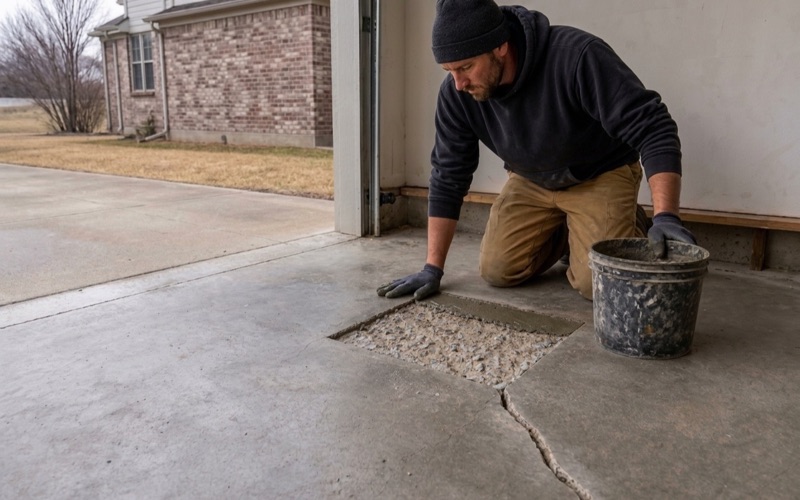
So a crack in a slab in this city is more likely to be settled and finished than to be permanently working. We still read the crack faces rather than assuming, because local drainage and a leaking line can move any slab, and where we do find one still moving we detail it as a flexible joint and say so before the job.
Looking for epoxy-flooring closer to Shady Hollow? See Epoxy-Flooring Services in Shady Hollow.
What Shallow Rock Puts in Place of Clay
Water That Cannot Go Down Goes Sideways
This is the part worth understanding, because it is the problem that replaces the one the shallow profile removed. Water reaching a bedrock contact eighteen inches down has nowhere to percolate to, so it moves laterally instead.
Lateral movement means water arrives at a slab edge and concentrates there rather than dispersing downward. That is a moisture condition at slab depth, and moisture at slab depth is the most common cause of a coating letting go anywhere in this trade.
Grading, Downspouts and What Sits Against the Building
Because of that, we pay more attention here than usual to what is happening outside the garage door. Where the ground falls toward a building, where downspouts discharge, and whether a patio or a driveway is directing water at the slab edge all matter more on shallow ground than on deep.
None of that is flooring work, and we will tell you when we see it. A floor coating installed over a slab that is being fed water from outside is a coating that will be blamed for a problem it did not cause and cannot fix.
Usually the fixes are cheap and belong to somebody else: an extended downspout, a regraded strip along one elevation, a drain that was never connected properly. Pointing them out before we quote is worth more to a customer than anything we could add to the specification.
Testing Rather Than Arguing About Heave
This is why we measure moisture instead of debating soil. We test with calcium chloride kits, in-situ relative humidity probes or a plastic sheet screen, and read the results against published thresholds rather than against a story about the region.
Where the numbers call for it, a moisture-mitigation primer goes into the scope as a priced line item before you sign. It is the one warranty exclusion you can genuinely buy your way out of in advance, and on ground that concentrates water at slab depth it earns its place more often than average.
A Young Slab Population, and What That Implies
Treat It as Post-Tensioned Until Established Otherwise
Around 87.9 percent of the housing stock here was built in 1980 or later and roughly 67.4 percent in 2010 or later. Post-tension slab construction became common in Texas after about 1980, which means a garage slab in this city should be treated as post-tensioned until it has been established otherwise.
That assumption has a direct and expensive consequence. Cutting, coring or drilling anchors into a post-tension slab risks severing a tendon, and a severed tendon is a structural repair carried out by a specialist rather than anything a flooring contractor can put right.
What We Do Before Anything Is Cut
Grinding and shot blasting are surface operations that go nowhere near reinforcement of either kind, so the great majority of a floor coating is unaffected. Where a crack needs opening we keep the rout shallow until the tendon layout is established, and where an operation cannot be moved we scan rather than accept the risk.
We also write into the proposal what will and will not be cut on a slab we believe to be post-tensioned. That leaves a record for you, for anyone who works on the slab later, and for us if the question comes up again in a few years.
The same proposal names the product, the coat-by-coat system build and the finished mil thickness. Two quotes for an epoxy garage floor can differ by half the material and read almost identically, and a written build is what makes them comparable and the finished floor auditable.
Residual Construction Moisture on Very New Concrete
With a third of this city’s housing built in 2020 or later, a meaningful share of the garages here sit on concrete young enough that residual construction moisture is still in play. That is a different reading from vapor drive through the ground, and both show up in the same test.
The preparation problem on a stock this new is also different from an older city’s. It is more often a builder-applied sealer or curing compound than thirty years of oil and hot-tire pickup, and it is close to invisible until tooling meets it.
What Preparation Actually Involves Here
Opening a Closed Builder Finish
Production-built garage slabs are power-troweled to a hard, tight surface with almost no porosity, and many still carry a curing compound sprayed on the day of the pour. Neither will accept a coating, and both are removed mechanically rather than chemically.
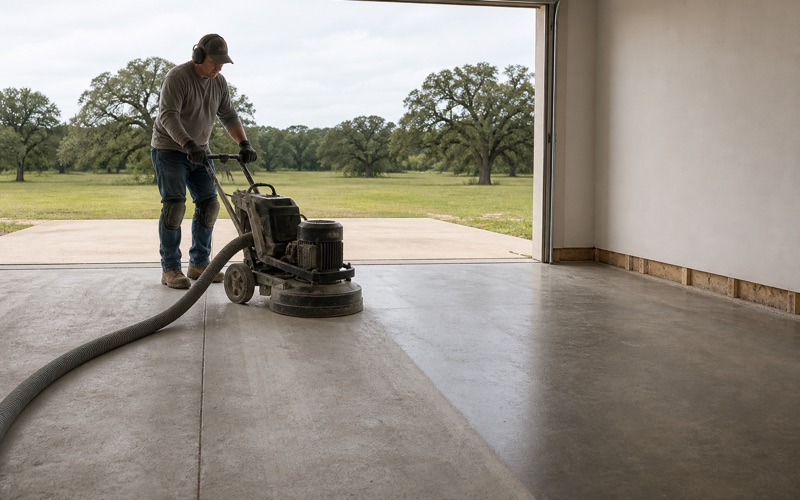
We open every slab with a diamond grinder or a shot blaster to a proper surface profile matched to the system going on top. We do not acid etch, because acid barely touches a dense troweled surface, leaves salts that have to be neutralized and rinsed, and puts water into a slab immediately before you want it dry.
Matching Tooling to the Concrete
Diamond segment bond hardness has to be matched inversely to concrete hardness, so a soft bond goes on hard concrete to keep exposing fresh diamond. New slabs in this city are frequently hard, and bringing the wrong bond means tooling that glazes over and stops cutting within the hour.
The edges matter as much as the field. A walk-behind machine cannot reach the last few inches against a wall or into a corner, and an unground perimeter is exactly where a coating starts to lift, so edge grinders and hand tools take those areas to the same profile.
The threshold is the other detail worth doing properly. We terminate at the door line with a saw-cut key or a clean chamfered edge so the coating has somewhere to end, rather than feathering it out to nothing that a warm tire can pick up on the first hot afternoon.
Manufactured Homes and What This Market Actually Is
One honest note about market size. Around 11.7 percent of this city’s housing stock is manufactured homes, and a manufactured home has no slab garage, so those units sit outside this market entirely rather than inside it.
That leaves an owner-occupied detached pool of roughly 810 units, about 72.1 percent of occupied units. It is a real market and it is smaller than a population figure suggests, and we would rather describe it accurately than quote a number that includes housing we cannot work on.
- 20+ Years in Central Texas
- Insured & Workers Comp Covered
- Free Written Estimates