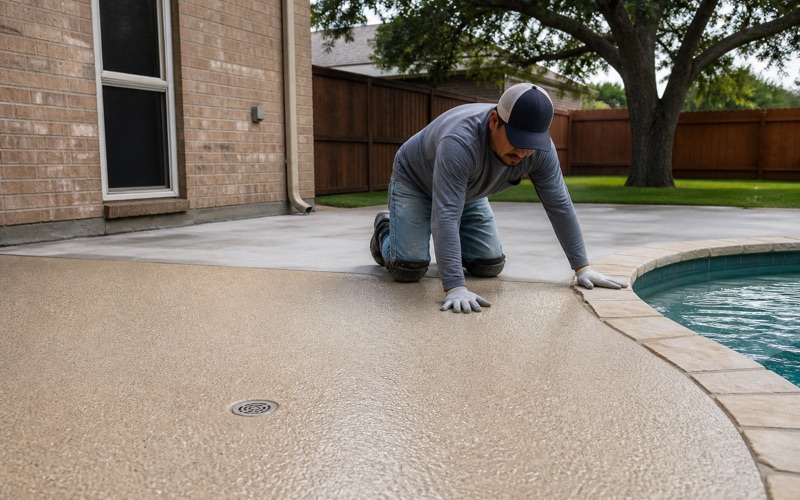
Pflugerville Epoxy Flooring installs epoxy flooring in Leander, and the ordinary first job in this city is not stripping a failed coating off a tired slab. It is putting the first coating a floor has ever carried onto concrete barely older than the house around it, which is a different job with a different set of problems.
We have been coating slabs across Central Texas for more than 20 years, and in older tract cities a great deal of our work is removal before anything else happens. Here that scope is the exception. The great majority of the garages in this city have never had anything on them except what the builder left behind.
That sounds like it should make the work easier, and in some respects it does. What it actually changes is where the difficulty sits: not in taking something off, but in getting a coating to bond to a dense, sealed, freshly finished slab that was never intended to receive one.
Most Garage Slabs Here Have Never Been Coated
A Stock Built Almost Entirely Since 1980
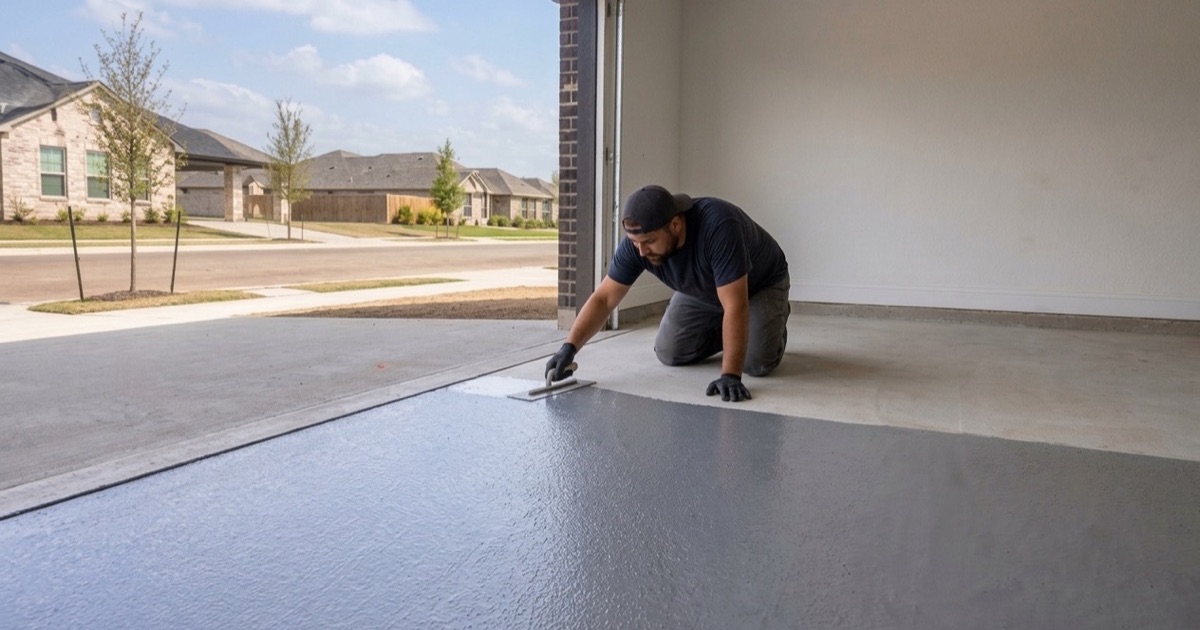
Around 97.5 percent of this city’s roughly 27,000 housing units were built in 1980 or later, and 62.6 percent, about 16,897 units, date from 2010 or later. Roughly 17.3 percent went up in 2020 or later. Only about 684 units in the entire city predate 1980 and only around 110 predate 1950.
That is one of the youngest housing stocks anywhere in our service area, and it means the failed-prior-coating scope that carries an older tract city simply does not describe this market. Most slabs here have never been coated at all.
What a First Coating Job Looks Like
On a floor with no history, the assessment is shorter and the preparation is not. There is nothing to diagnose about a previous failure and nothing to remove in the sense of a bonded film, which takes real time out of the job.
What remains is the whole of the surface question. The concrete is dense, hard and closed, and everything in the specification follows from opening it properly rather than from working around somebody else’s mistake.
It also means the timeline is more predictable. Removal is the part of a coating job that reliably surprises people, because nobody knows how hard a film will fight until the tooling meets it, and a slab with no film has none of that uncertainty in it.
Who Actually Owns the Slab
Roughly 2,962 single-family detached units here are renter-occupied, about one detached house in seven. That is a smaller share than in several neighboring cities and it is not negligible, and it means a meaningful number of garage decisions run through a landlord rather than the person parking in the space.
Rental work is bought on durability, cleanability and turnover rather than appearance, and it has to fit a vacancy window that is usually short and rarely movable. We quote and schedule it on those terms instead of handing a landlord a homeowner’s proposal.
Looking for epoxy-flooring closer to Lost Creek? See Epoxy-Flooring Services in Lost Creek.
What a Builder Leaves Behind
Cure-and-Seal and Curing Compounds
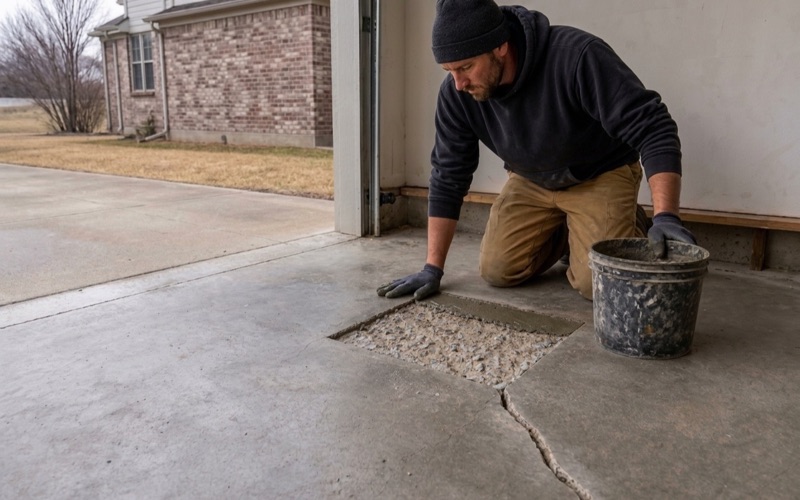
New concrete is almost always sprayed with a curing compound or a combined cure-and-seal product on the day it is poured, because that is how the pour is protected while it gains strength. Those products are designed to sit on the surface and slow moisture loss, which is exactly the opposite of what a coating needs.
They are also close to invisible. A water-bead test tells you something is there, and it will not tell you how much or how evenly, which is why the answer is mechanical removal across the whole floor rather than spot treatment.
A Closed Power-Trowel Finish
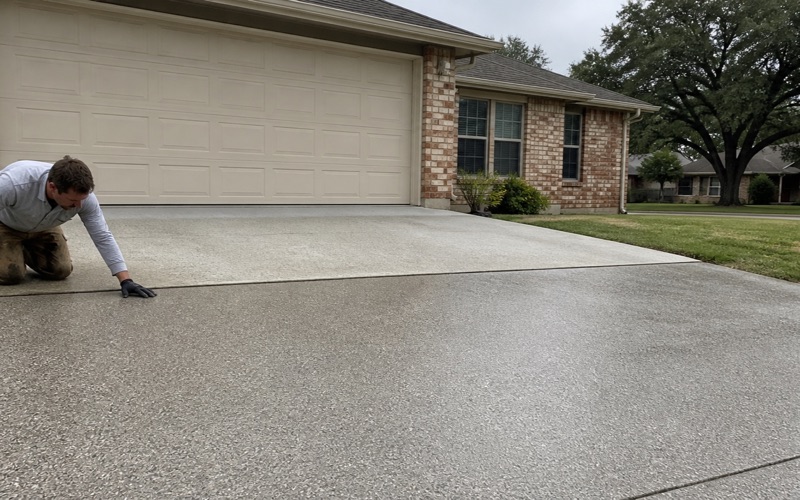
Production-built garage slabs are power-troweled to a hard, tight, almost burnished surface. That finish is a good thing structurally and a genuine problem for adhesion, because it leaves almost no porosity for a coating to key into.
A coating laid onto a troweled surface bonds to a thin skin rather than to the concrete beneath it, and when that skin lets go the floor comes away in sheets. That single mechanism accounts for a large share of the failed first coatings we are called out to look at.
The newer the slab, the more consistently this is true. A twenty-year-old garage has usually had some of that surface worn or weathered away in patches, while a two-year-old one has it intact everywhere.
Grinding to Profile Instead of Etching a Dense Floor
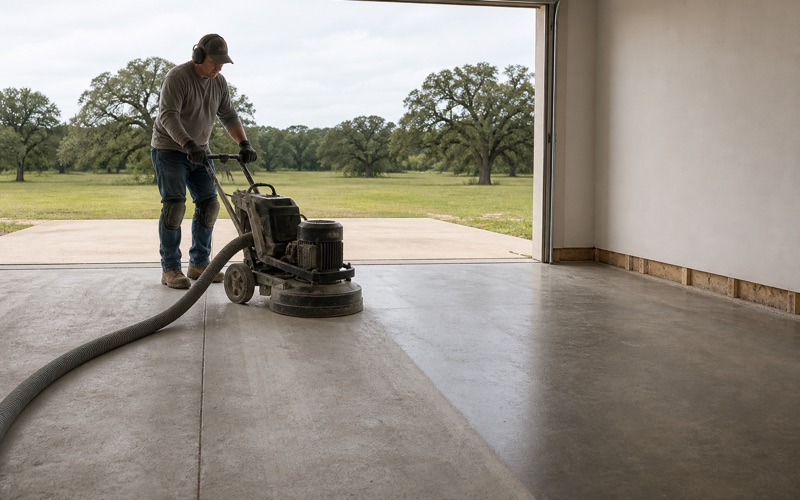
Every slab we coat is opened mechanically with a diamond grinder or a shot blaster to an ICRI CSP profile suited to the system thickness, and we do not acid etch. On a dense modern slab acid barely touches the surface, leaves salts behind that have to be neutralized and rinsed, and puts water into concrete immediately before you want it dry.
Diamond segment bond hardness has to be matched inversely to the concrete, so a soft bond goes on hard concrete to keep exposing fresh diamond. New slabs here are frequently hard, and bringing the wrong bond means tooling that glazes over and stops cutting within an hour.
The edges matter as much as the field. A walk-behind grinder cannot reach the last few inches against a wall or into a corner, and an unground perimeter is precisely where a coating begins to lift, so edge grinders and hand tools take those areas to the same profile.
A Young Slab Still Gets a Moisture Test
The Garage Exemption That Does Not Depend on Build Date
Here is the part most homeowners in a new house have never been told. The residential code requires an under-slab vapor retarder beneath a heated slab, and it expressly exempts garages and other unheated accessory structures from that requirement.
That exemption is era-independent. It is not a builder cutting a corner and it has not changed across recent editions, so the garage slab in a house finished last year is very likely sitting on grade without the protection the living space a few feet away has.
What We Measure, and Against What
We test with calcium chloride kits to measure the moisture vapor emission rate, with in-situ relative humidity probes that read conditions inside the slab itself, or with a plastic sheet screen where a quick indication is enough. The results are read against published thresholds rather than against an impression of the floor.
That is the only way to know. There is no visual sign of a slab passing vapor until a coating has already blistered, and by then the fix is a full removal and reinstallation rather than a primer.
A newly poured slab has an additional consideration, which is that concrete continues releasing water for a long time after it is walkable. On a very recent pour the reading is as much about how much time has passed as about what is under the slab, and it is worth measuring rather than working from a rule of thumb.
Mitigation as a Priced Line Item
Where the numbers call for it, a moisture-mitigation primer goes into the scope of work as a priced line before you sign anything, rather than being sold as an extra after a floor has failed. That way you know the cost up front and you know why it is there.
It is also the one warranty exclusion you can genuinely buy your way out of in advance. Substrate movement and moisture lead almost every coating warranty exclusion list, and only one of them can be measured and treated before the work starts.
We read those exclusions out before the job is sold rather than leaving them in a document nobody opens. A crack over ground that is still working gets routed and filled with a semi-rigid polyurea as a moving joint, and we tell you in advance that it can telegraph through again.
Codes, Counties and the Edge of the City
An Unusual Code Pairing Worth Checking
This city’s adopted 2021 code package sits alongside the 2023 National Electrical Code, published as a separate local amendment. That is an electrical edition two cycles ahead of the rest of the package, which is an unusual pairing and worth checking rather than assuming.
It matters on commercial work more than residential. A specification written against another jurisdiction’s package does not transfer across the city line, and we read the applicable edition off the city rather than off the metro.
Two Counties, Two Appraisal Districts
The city’s boundaries fall in both Williamson and Travis counties, and the city’s own tax tables carry separate rates and separate appraisal districts for each. Which county a job sits in is a live question here rather than an administrative footnote.
Permitting for work inside the city limits runs through the city’s own portal, which carries development services, fire and code enforcement together with a status dashboard. For a commercial job that is genuinely convenient, because the fire review and the building review are visible in the same place.
A commercial kitchen floor is the one exception worth flagging, because the city’s own ordinances require county health district inspection before an initial permit or a renewal. That review is where the smooth, durable and coved-base requirements actually live, and we build an integral coved base to that reading rather than to a generic specification.
Outside the City Limits, Authority Changes
On the Williamson County side, work outside the city limit is a different position entirely. The county has adopted no residential building code for unincorporated areas, has no zoning authority and cannot issue a certificate of occupancy, with commercial and multi-family construction permitted through the county fire marshal instead.
So we confirm which authority actually has a site before the first visit rather than reading it off a mailing address. And as everywhere in Texas, there is no flooring or coatings license to hold, so what we show instead is general liability cover, workers compensation and a sales and use tax permit.
- 20+ Years in Central Texas
- Insured & Workers Comp Covered
- Free Written Estimates