Pflugerville Epoxy Flooring installs epoxy flooring in Lost Creek, a neighborhood with two unusual properties that both matter to a floor job. It was built inside one closed window between 1960 and 1990, and on 9 September 2024 it stopped being part of the City of Austin.
We have been coating concrete across Travis County for more than 20 years, and it is rare to be able to say anything this definite about a slab before seeing it. Here the construction era is genuinely narrow, which fixes a great deal about what the concrete is and how it behaves.
The jurisdiction change is the other half. Any quote, any specification and any source written before September 2024 names the wrong authority for this neighborhood, and that is a live problem rather than a historical footnote for anyone doing commercial work here.
A Neighborhood With a Start Date and an End Date

Nothing Before 1960, Very Little After 1990
Of roughly 424 housing units here, none were built before 1960. About 121 went up in the 1960s and 137 in the 1970s, with 60.8 percent of the stock predating 1980 and 75.5 percent predating 1990. Only around 52 units, some 12.3 percent, date from 2000 or later.
A window closed at both ends is genuinely useful information. Most communities we work in have a long tail in one direction or the other, and this one does not, so the dominant slab form here is a known quantity rather than something to be discovered on each visit.
What That Fixes About Your Slab
It means the great majority of garages here sit on conventionally reinforced ground-supported slabs from before the post-tension era. That is a meaningful difference, because on a post-tension slab nothing can be cored, routed or saw-cut until the tendon layout is established.
Here that constraint largely does not arise, so a crack can be opened into a proper joint and a repair can be taken to the depth it needs without a scanning step first. It makes the work more straightforward and it makes the estimate more reliable.
Slabs of that era also tend to have their control joints laid out on a wider spacing than modern practice, and some have none at all. Those lines still have to be carried through the finished floor and filled flexibly rather than coated solid across, because the concrete will keep working at them regardless of what is on top.
Margins Worth Naming
One honest caveat. The estimates for a place this size carry wide margins of error, roughly plus or minus 113 on the total unit count and comparable figures on the individual decade counts.
So the shape of the distribution is solid and the individual numbers are soft. We use them as a description of the neighborhood rather than as a count, and nothing we plan depends on any of them being exact.
Looking for epoxy-flooring closer to Steiner Ranch? See Steiner Ranch Epoxy-Flooring.
Conventionally Reinforced Slabs, and How They Crack
Reading Cracks on Ground That Barely Moves
The soil mapped here includes Real, a shallow carbonatic soil running around 25 percent clay with a plasticity index of 14.3 and a linear extensibility of about 1.11 percent. That is the lowest-movement material measured anywhere in our service area.
Linear extensibility measures how much a soil changes dimension between wet and dry, so a figure that low means seasonal ground movement is a minor factor here rather than the governing one. That is the opposite of the position on the Blackland side of the metro, and it changes what a crack in your floor most likely means.
What a Crack Probably Is Here
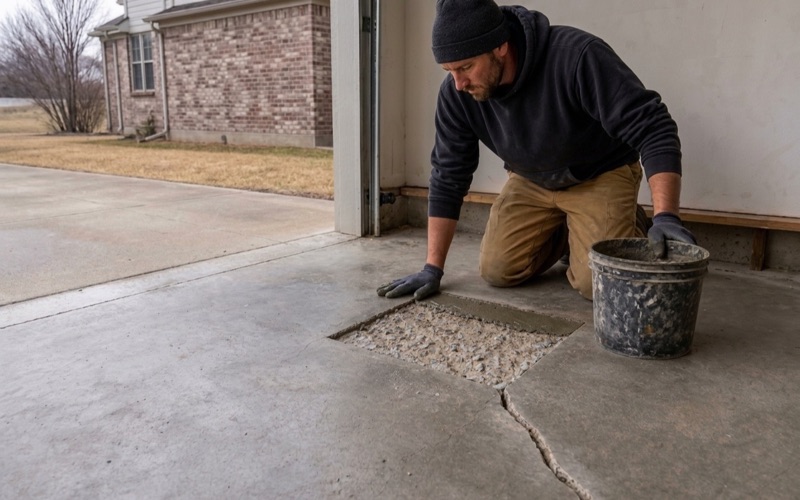
Where the ground barely moves, a crack in a fifty-year-old slab is far more likely to be settled and finished than active. A settled crack has worn, closed faces and matched offsets, and it can be routed, filled with a rigid epoxy and ground flush with a reasonable expectation that it stays gone.
We still check rather than assume, because low movement is not no movement and drainage, tree roots and a leaking line can all move a slab locally. But the honest starting expectation here is a repair rather than a permanent working joint.
That expectation is worth having before the visit rather than after it, because it changes the shape of the quote. A floor whose cracks can be closed permanently reads very differently from one carrying two or three joints that will always be visible lines in the finish.
Why That Changes the Specification
It means fewer flexible joints carried through the finished floor and a cleaner-looking result, and it means we are not obliged to warn you about telegraphing on every line in the concrete.
Where we do find an active crack we treat it properly, routing it and filling with a semi-rigid polyurea sized to move, and telling you before the job that it can show through again. A coating is a film a few thousandths of an inch thick that follows the slab, and that remains true wherever the slab is.
Prior Sealers and Decades of Use
What Is Usually on the Floor Already
A garage floor that has been in service since the 1960s or 1970s has accumulated things. Sealers applied at some point and never fully worn off, paint from other projects, adhesive from whatever was once laid down, and oil that has soaked into the concrete rather than sitting on top of it.
None of that is unusual and all of it has to be dealt with before anything bonds. Penetrated oil is the one that costs real time, because it has to be degreased and then mechanically removed down to sound material rather than sealed over.
Removing It Without Wrecking the Slab
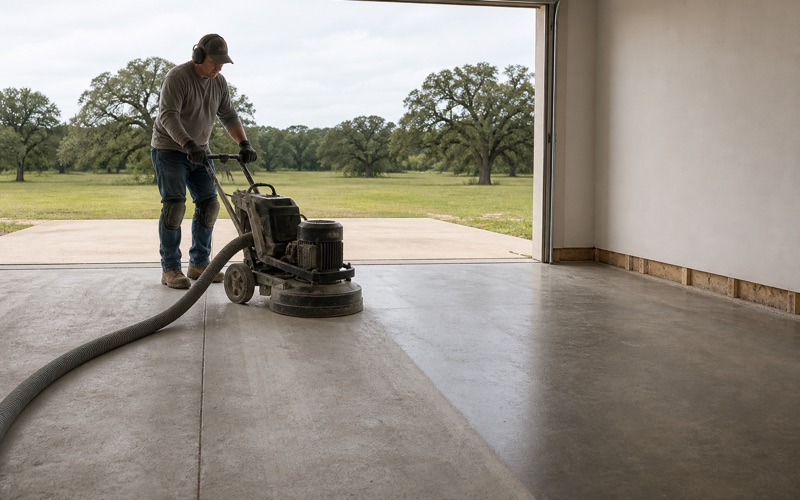
We take films and residues off with PCD tooling and diamond grinding, moving to a shot blaster where a coating is thick or stubbornly bonded. The aim is to remove what is on the concrete and leave a sound, profiled slab, not to chase a film so hard that the surface is torn open.
We never install over an existing sealer, and we do not put a new coating over an old one that is letting go. A new system is only ever as attached as the layer beneath it.
Where the surface of the concrete itself has spalled or delaminated after decades of use, there is nothing sound left to coat and the answer is resurfacing before any system goes on. We sound the slab before quoting so that appears as a priced item rather than as a discovery with a crew already on site.
Moisture Testing on an Older Garage Slab
The under-slab vapor retarder requirement carries a garage exemption that does not depend on the year the house was built, so a moisture test is operative on a slab of this age exactly as it would be on a new one.
We measure with calcium chloride kits or in-situ relative humidity probes, read the results against published thresholds, and price a moisture-mitigation primer into the scope where the numbers call for one. It goes in as a line item before you sign rather than being sold after a floor has blistered.
On an older detached or semi-detached garage there is a second reason to measure. Drainage around the building has usually changed over fifty years as landscaping and paving were added, and a slab that was dry when it was poured is not necessarily dry now.
The Authority Changed in September 2024
Disannexed From the City of Austin
Austin City Council approved the disannexation of this territory effective 9 September 2024, covering roughly 738 acres adjacent to the Barton Creek Greenbelt. The City of Austin has not been the permitting authority here since that date.
The mailing address still says Austin, and point queries across the neighborhood return no incorporated place at all. That combination is exactly the kind of thing that sends a contractor to the wrong counter, and it is the single fact on this page most likely to be stated wrongly elsewhere.
Travis County and the Fire Marshal
Authority now sits with Travis County and the Lost Creek Limited District. For commercial, public and multi-family construction and for change-of-use work, the Travis County Fire Marshal’s Office requires plan review and a permit, and effective 1 January 2026 the applicable code is the 2021 International Fire Code with local amendments.
Fire response is Travis County Emergency Services District No. 9, served by the Westlake Fire Department, and law enforcement is the county sheriff’s office rather than Austin police. For a commercial kitchen the health authority remains Austin Public Health, which covers unincorporated Travis County by agreement, so that one did not change.
Why Every Older Source Names the Wrong One
This is worth stating plainly because it will keep catching people out for years. Anything written about permitting in this neighborhood before September 2024 describes a City of Austin process that no longer applies here, and search results do not carry a date stamp on the page.
We confirm the current authority before the first visit rather than relying on any of it. On a residential garage coating this rarely changes what happens, since there is generally nothing to apply for either way, and on commercial work it changes everything about the sequence. Utility service is a separate question and not a jurisdictional one: a property served by Austin Water is a customer of that utility, which tells you nothing about who permits work on the building.
What We Show Instead of a License
Texas licenses no flooring, coatings, painting or general contractor, and neither the county nor the district adds one here. There is no license number for a floor coating to hold.
What we produce is general liability cover, workers compensation and a Texas sales and use tax permit, sent before the job. Every owner-occupied unit in this neighborhood is a detached house, so the person we are talking to is almost always the owner of the slab, and that proposal is written for them to check rather than to trust.
- 20+ Years in Central Texas
- Insured & Workers Comp Covered
- Free Written Estimates