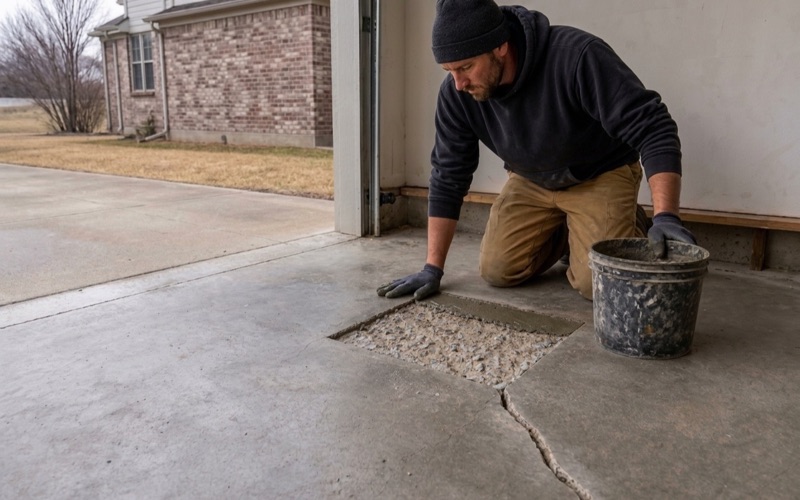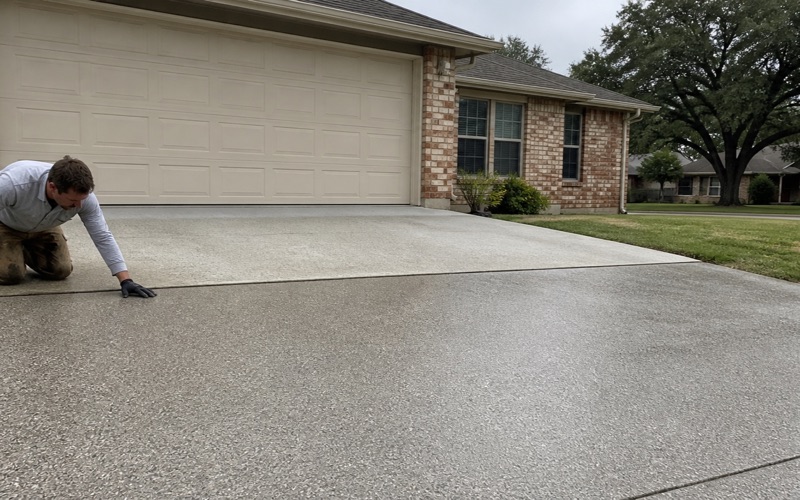
Pflugerville Epoxy Flooring installs epoxy flooring in Manchaca, and this community makes an argument better than anywhere else we work. A garage slab poured in the 2010s was still allowed to be poured with nothing underneath it, which makes the newest housing stock on our list the place where a moisture test earns its keep most clearly.
We have been coating concrete across Travis County for more than 20 years, and the usual assumption a homeowner brings is that a recent house is a solved problem. On the living space that is broadly fair. On the garage it is not, and the reason is written into the code rather than into any builder’s shortcuts.
So this page is about moisture: what the exemption actually says, what each of the two standard tests measures, and why we put the test into the scope as a priced line rather than selling it after a floor has blistered. It also covers what a stock built almost entirely in one decade implies about the slab itself.
New Concrete Is Not Dry Concrete
A Stock Built in One Decade
Around 61.2 percent of this community’s housing units were built in the 2010s, and roughly 84.8 percent date to 2000 or later. That is one of the newest stocks anywhere in our service area, and it rules out most of the arguments that carry an older community.
There is no meaningful population of worn slabs here, very little that has been coated once already, and almost nothing from before modern construction practice. What remains is a set of questions specific to young concrete, and they are different questions rather than easier ones.
Two Separate Sources of Water
There are two things a moisture reading can be picking up on a slab like this, and it is worth separating them. One is residual construction moisture, which is water still leaving concrete that has not finished drying, and it declines over time.
The other is vapor drive from the ground, which does not decline at all. It continues for the life of the slab, and whether it is present depends on what is underneath the concrete rather than on how long ago it was poured.
Why the Distinction Matters to You
If a reading is high because the slab is young, waiting is a genuine option and we will say so. If it is high because there is nothing under the slab, waiting achieves nothing and the answer is a moisture-mitigation primer written into the specification.
Only a measurement separates the two, and getting it wrong in either direction costs money. Coating too early on a drying slab produces a failure that looked avoidable; specifying mitigation that was not needed adds cost that bought nothing.
We would rather be the contractor who tells you to wait six weeks than the one who takes the deposit and comes back to argue about a blistered floor. The test is inexpensive relative to either mistake and it takes the guesswork out of a decision that is otherwise made on optimism.
Looking for epoxy-flooring closer to Cedar Creek? See Epoxy-Flooring Services in Cedar Creek.
The Garage Exemption in the Vapor Retarder Rule
What the Code Actually Says
The residential code requires a vapor retarder between the slab and the base course under a heated slab, and its exceptions include garages, utility buildings and other unheated accessory structures. That exemption is written into the model code rather than added by any state or city.
It is also era-independent. It has not changed across recent editions, which is why a garage poured in the 2010s was allowed to be poured without a retarder underneath it exactly as one poured decades earlier was.
Not a Builder Cutting Corners
We are careful about how we say this, because it is easy to hear as an accusation. It is not. A builder who omits an under-slab retarder beneath a garage is following the code as written, and the heated part of the same house very likely has one.
The practical result is a garage slab sitting on grade with less protection than the living space three feet away, in a house that is otherwise entirely modern. A newer house is not automatically a safer garage, and that sentence is the whole reason this page exists.
What No Source Can Tell You
We will also be honest about the limit of the argument. No available source establishes the slab specification or whether a vapor retarder is present under any individual house here. Build decade does not establish construction detail.
That is precisely why the answer is a test rather than an inference. We measure the slab in front of us rather than reasoning from what was probably done, because probability is not a specification. It is also the only version of this conversation that stays honest, since a contractor cannot know what is under a slab they did not pour and no amount of confidence substitutes for a reading.
What Each Test Actually Measures
Calcium Chloride
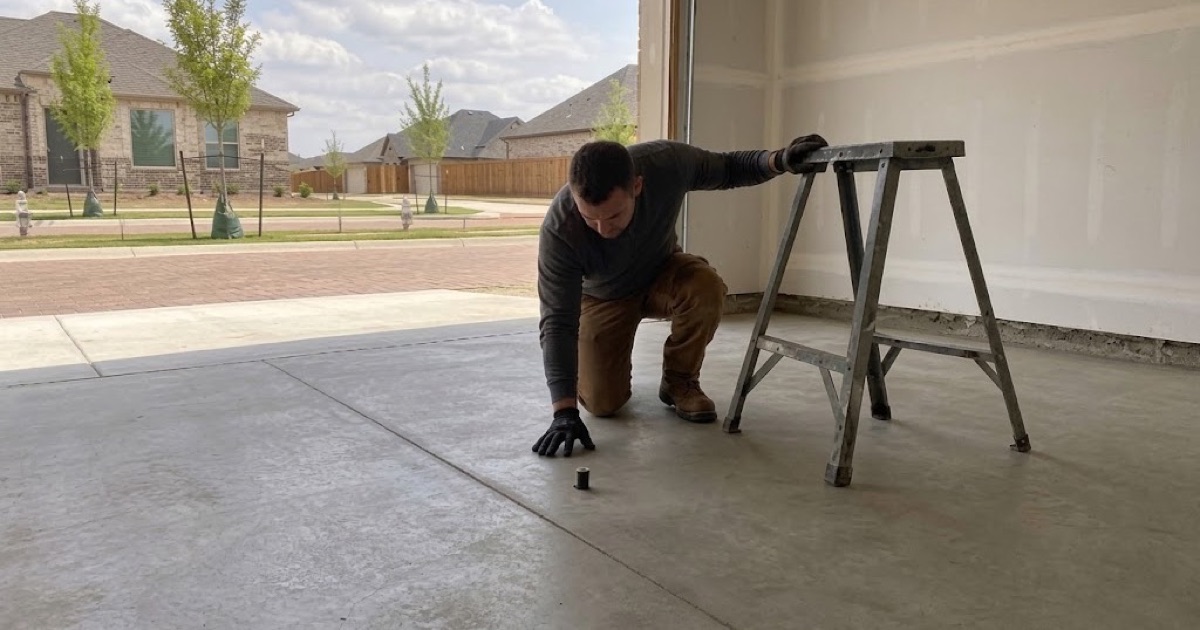
The calcium chloride test measures a moisture vapor emission rate: how much water is coming out of the top surface of the slab over a set period, expressed as a weight over an area over time. A dish of anhydrous calcium chloride is sealed to the floor under a dome and weighed before and after.
It measures what is leaving the surface, which is the thing a coating has to cope with. Its limitation is that it reads the top portion of the slab and can be influenced by the conditions in the room during the test, so ambient conditions have to be controlled and the test area prepared properly beforehand rather than simply taped down onto whatever the floor happens to be carrying.
In-Situ Relative Humidity Probes
Relative humidity probes work differently. A hole is drilled to a specified depth in the slab, a sleeve is installed, the hole is allowed to equilibrate, and a probe reads the relative humidity inside the concrete itself.
That reads the internal condition of the slab rather than the surface emission, which makes it a better predictor of what happens once a coating seals the top and moisture redistributes. On a young slab in particular it is the more informative of the two.
Reading Them Against a Threshold
Either way, a number on its own means nothing until it is read against a published threshold for the system going down. We read results against the relevant standard rather than against a feeling about the floor, and we record the readings.
Where the numbers call for it, a moisture-mitigation primer goes into the scope as a priced line item before you sign. It is the one warranty exclusion you can genuinely buy your way out of in advance, since substrate movement and moisture lead almost every exclusion list and only one of them is measurable beforehand.
The Slab, the Pool and the Authority
Post-Tension Is the Default Here
Because the stock is overwhelmingly recent, a monolithic post-tension slab under an attached two-car bay is the default assumption rather than the exception. Coring, drilling or saw-cutting needs the tendon layout established first, because severing a tendon is a structural repair rather than a floor repair.
Grinding and shot blasting are surface operations and go nowhere near reinforcement, so most of a coating job is unaffected. Where a crack needs opening we keep the rout shallow until the layout is known, and we write into the proposal what will and will not be cut.
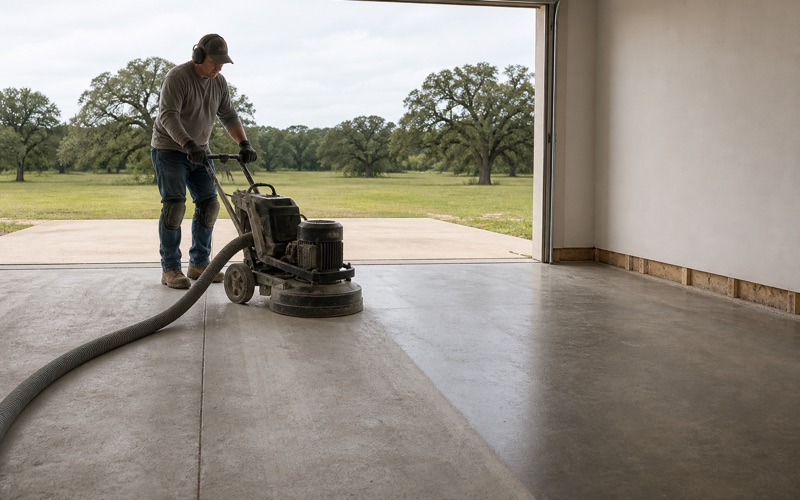
The builder finish is the other thing a slab this new brings. Production garages are power-troweled to a hard, closed surface and frequently still carry a curing compound, so every slab is opened mechanically with a grinder or a shot blaster to a proper profile. We do not acid etch and we never coat over an existing sealer.
Counting the Real Pool
About 91 of this community’s 895 housing units are mobile homes, and a manufactured home has no poured garage slab. So the addressable pool here is roughly 561 owner-occupied detached houses rather than the 609 owner-occupied units a headline figure would suggest.
We make that subtraction because a figure that skips it overstates the market by nearly a tenth. Roughly one in six of the occupied detached houses is rented, which is a landlord conversation rather than a homeowner one and gets quoted on durability and turnover instead of appearance.
No City, and a Spelling Worth Getting Right
This is an unincorporated census-designated place. Point queries across it return no incorporated place at all, so the Austin mailing address is not a jurisdiction, there is no city building department to call and no city inspection to schedule. For commercial, public and multi-family work the authority is the Travis County Fire Marshal’s Office.
One last local note. The community is named for Manchaca Springs and for Jose Antonio Menchaca, and the post office ran through Manchac House in 1851, Manchac in 1874 and Manchaca from 1881. The spelling has history behind it and local readers notice when it is wrong.
About one unit in nine here is vacant at any time, which is worth mentioning because a vacant house is a different job from an occupied one. The garage is already empty, the schedule is not built around a family’s cars, and the work can generally run straight through rather than around a household.
- 20+ Years in Central Texas
- Insured & Workers Comp Covered
- Free Written Estimates