Pflugerville Epoxy Flooring installs epoxy flooring in Manor, and this is the one city on our list where the ground under the slab is the whole conversation. Not because the coatings are different, but because the soil map here is close to unanimous in a way that almost nowhere else in our service area is.
More than 20 years of work on Central Texas concrete has taught us to treat the substrate as the specification and the resin as a finish decision. In most cities that means finding out which of several soil regimes a particular street sits in. In Manor it means something more specific, which is that the reactive answer is almost certain and the newness of the slab does not soften it.
That combination is unusual and it is worth stating plainly, because it runs against the intuition most homeowners bring. A recently built house feels like a solved problem. Underneath, the ground is doing exactly what it has always done, and a coating a few thousandths of an inch thick has no opinion about it either way.
What an Almost Entirely Vertisol Map Means Underfoot
Houston Black, Heiden, Tinn and Ferris
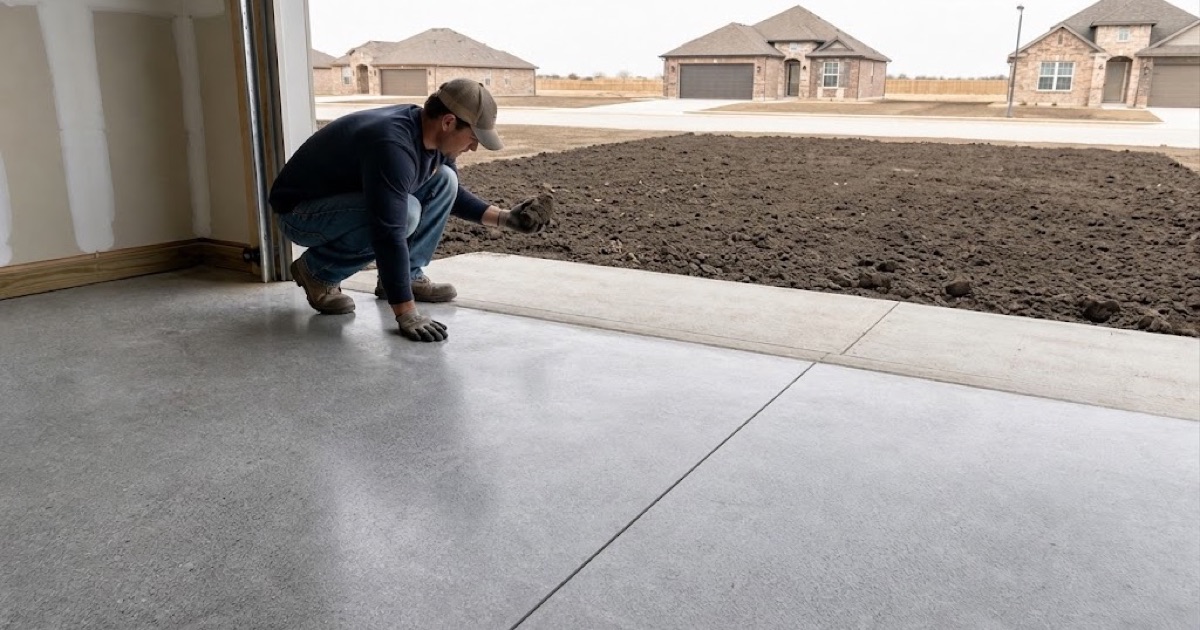
Vertisols cover 97.8 percent of Manor’s mapped area, which is effectively the whole city. Houston Black alone accounts for 54.6 percent, with Heiden at 23.5 percent, Tinn at 10.3 percent and Ferris at 6.2 percent. A Vertisol is defined by its smectitic clay mineralogy, the family of clays that take water into their structure and swell, then release it and shrink.
There is no meaningful part of this city where that is not the answer. In several communities nearby we have to establish which regime a given address falls into, because the map genuinely changes street by street. Here it does not, and that certainty is useful rather than alarming. It means we can bring the right joint filler and the right expectation to a first visit instead of hedging, and it means the estimate does not carry a contingency for a soil regime that will not turn up.
Plasticity Index and Linear Extensibility, as Numbers
The word expansive is doing a lot of work in most conversations about Central Texas soil, so it is worth replacing it with measurements. Houston Black carries a plasticity index of 44 and a linear extensibility of 12. Ferris, which covers a smaller share of the city, reaches a linear extensibility of 16.14.
Linear extensibility is a direct measure of how much a soil changes dimension between wet and dry. Those are not adjectives that can be argued about, and they are the reason we specify joint and crack detail here from the ground condition rather than from the product catalog. A number also survives being passed on to somebody else, which an adjective does not.
What USDA Rates This Ground For
The United States Department of Agriculture rates soils for small commercial buildings, and it rates this ground Very limited across 83.6 percent of the city, naming shrink-swell as the limiting feature. That rating is about foundations and structures rather than about coatings, which is precisely why it is worth quoting.
It tells you the ground is a recognized engineering constraint, assessed by somebody with no stake in selling you a floor. We use it the same way, as context for what a coating can and cannot do rather than as a reason to sell a more expensive one.
Looking for epoxy-flooring closer to Hutto? See Epoxy-Flooring in Hutto.
New Slabs on Old Ground
Why a Modern Slab Does Not Settle the Question
Around 94 percent of the housing here was built in 2000 or later and the median year built is 2015, which makes this one of the newest housing stocks anywhere in our service area. That rules out several arguments that apply elsewhere: there is no meaningful population of old slabs, and the failed-prior-coating story that fits some neighboring cities does not fit this one.
What it does not rule out is movement. A modern slab is engineered, reinforced and generally poured over a vapor retarder, and it still sits on ground that changes dimension with the season, so good construction manages that rather than abolishing it.
The argument on a Manor garage is therefore neither a missing vapor retarder nor a coating that has already failed. It is simply what reactive ground does beneath a slab that is otherwise entirely modern, and it has to be detailed for rather than explained away.
What We Test on a Recently Built Garage
We test moisture on new slabs as readily as on old ones, using calcium chloride kits or in-situ relative humidity probes and reading the result against published thresholds. Newer construction is not automatically dry, and a garage slab in particular has less protection than the heated part of the house.
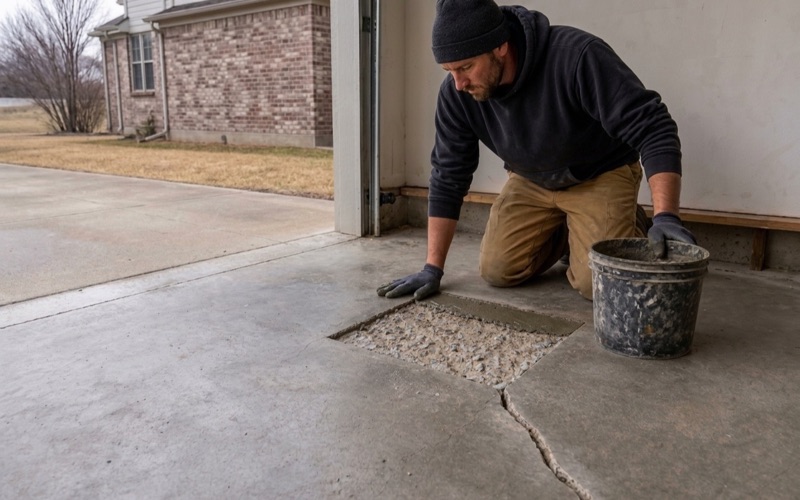
We also look at what the surface was finished to. A production-built garage is usually power-troweled hard and closed, sometimes with a curing compound still on it, and neither will accept a coating until the surface is opened up mechanically.
Crack Detail Over Ground That Moves
Where a crack is still working seasonally, we route it out and fill it with a semi-rigid polyurea sized to move, then carry the coating over it and tell you before the job that it can telegraph through again. That disclosure is the point. A film this thin follows the slab, and no coating we or anyone else installs resists or absorbs ground movement.
Where a crack has settled and finished moving, it is a different repair entirely and generally stays gone. Distinguishing the two on your floor, rather than treating every crack the same way, is most of what a careful estimate is actually doing.
Two-Car Garages on Small Platted Lots
The Work That Is Actually Here
Manor is a platted-lot city rather than an acreage city. Of the appraisal-district parcels lying wholly inside the city limits the median is about 0.143 acres, and only 3.7 percent reach a full acre. The practical consequence for this trade is that the work available inside the city is attached two-car and three-car garages, not detached shop slabs on rural lots.
That shapes what we bring and how we price. It is a residential garage market with a straightforward scope, and we would rather scope it honestly than pretend a market exists here that the parcel data says does not.
Access, Staging and Driveway Width
On lots of that size, access is measured in feet rather than in gate widths, and the driveway is both the route in and the staging area. Grinders, shot blasters, vacuums and material all have to fit on it without blocking the street or the neighbors.
We walk that at the estimate rather than discovering it on the morning. It also affects containment, because dust control on a tight lot means keeping the extraction close to the tool rather than relying on distance. On a street of houses built to the same plan at the same time, the neighbors are close enough that how we manage dust and noise is part of the service rather than an afterthought.
Detached Workshops as Permitted Structures
Where there is a detached building, it is worth knowing the city requires a construction permit for sheds and storage buildings over 64 square feet, with setback and final inspections. A workshop slab here is a permitted structure rather than an unregulated pour.
That matters mostly for sequencing. If the building itself is still in the permit process, the floor coating waits for the structure to be signed off rather than the other way around, and we would rather say that at the quote.
Scheduling Around a City That Commutes
Long Commutes and When a Walkthrough Can Happen
Of the workers here who do not work from home, roughly two thirds travel 30 minutes or more each way and a meaningful number travel an hour or more. A weekday-morning walkthrough simply misses most of this market.
So we schedule estimates around that rather than around our own convenience, which usually means evenings and weekends for residential work. It is a small accommodation and it is the difference between quoting a job and never meeting the customer. The same logic applies to the work itself, because a garage floor needs the space cleared and the car parked elsewhere for several days, and that is easier to arrange when it has been planned around a real household schedule.
The City Permits, Not the County
Inside the city limits, Manor is the permitting authority and no county building code applies. That is the opposite of the position in the unincorporated communities nearby, and the two should not be conflated.
A Manor mailing address is not the same thing as a Manor jurisdiction, and addresses on roads just outside the limits geocode to unincorporated Travis County with no incorporated place at all. When a job sits near that line we confirm which authority has it before the first visit.
A Separate Fire-Code Review for Commercial Work
For commercial jobs there is a second review worth knowing about. Travis County Emergency Services District No. 12 runs its own fire-code review separate from the city’s building permit, with its own submission route.
A coating job that changes interior finish or occupancy should be checked against that review as well as the city’s. Two counters rather than one is not a problem when it is planned for, and it is a genuine delay when it is discovered late.
- 20+ Years in Central Texas
- Insured & Workers Comp Covered
- Free Written Estimates