
Pflugerville Epoxy Flooring installs polyaspartic floor coating systems across Pflugerville, TX and the surrounding cities including Wells Branch, Round Rock, Manor, Hutto and Brushy Creek. We have been specifying and applying resin floors here for more than 20 years, which is long enough to have watched polyaspartic go from a niche topcoat to the default finish layer on most of the floors we build.
Polyaspartic is a polyurea, and what makes it useful is the width of the conditions it will tolerate. Where an epoxy wants a substrate at 50 degrees or warmer and a comfortable humidity, several polyaspartics are published for application across an enormous temperature range and in high humidity, and they cure fast enough that a full floor can go down and be walked on the same day. That combination is why a one-day garage floor is possible at all.
It is not, however, a magic product, and we will not sell it as one. Fast cure means a short working time, ultraviolet stability does not confer adhesion, and no topcoat compensates for a slab that was not opened up properly or tested for moisture. Below is what polyaspartic genuinely does better, where we use it, and the tradeoffs we would want to know about if we were the ones buying.
Where Polyaspartic Beats an Epoxy, and Where It Does Not
Ultraviolet Stability and Color Retention
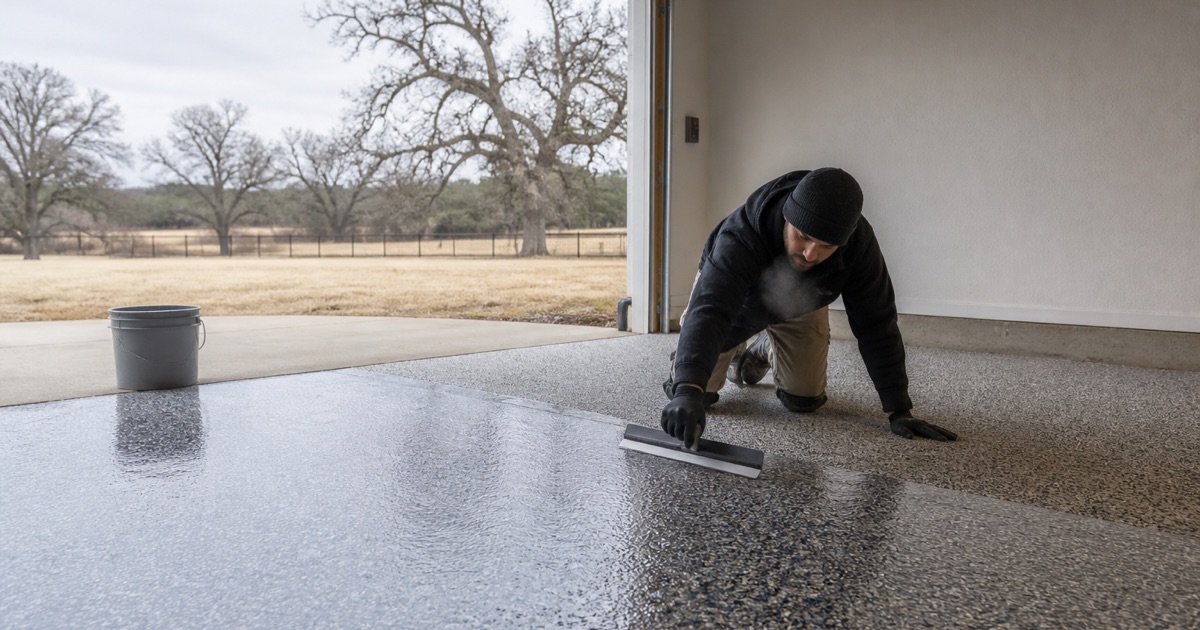
Epoxy is not ultraviolet stable. Put it in sunlight and it ambers, chalks and dulls, which is invisible under a dark flake blend and glaringly obvious on a white, gray or light metallic floor. Polyaspartic and polyurea chemistries hold their color under direct sun, so any floor that sees daylight gets one as the top layer. In practice that means every garage with a door that spends the afternoon open, every patio and pool deck, every dock and every entry, and it is the reason we rarely finish a floor with epoxy on top even when epoxy is doing the structural work below.
Temperature Range, Humidity Tolerance and the Application Window
The substrate rules are what separate the two chemistries on a Central Texas job. Epoxy floor coatings are typically published for application from 50 degrees at the substrate upward, with a ceiling near 100 degrees, and they need to stay 5 degrees above dew point at the surface throughout. Several polyaspartics extend the low end far below freezing and tolerate high humidity, which turns a January morning from a lost day into a working one. Be careful with that generalization, though, because not every polyaspartic is rated so low and one common product publishes a minimum surface temperature of 40 degrees, which is why we quote the product rather than the chemistry.
Pot Life, Recoat Windows and Why Speed Cuts Both Ways
Fast cure is the headline feature and the main hazard. A polyaspartic can have a working time measured in minutes rather than hours, and on a warm slab it shortens further, so a crew that mixes a full batch and then hits a problem has a pail turning to rubber while they solve it. We mix in half batches with a dedicated mixer and enough spreaders to place each one inside its window, and we plan the recoat timing before the first coat goes down, because the window to bond the next layer chemically also closes fast.
Systems We Build With Polyaspartic
One-Day Flake Floors Over a Polyurea Primer
The fastest system we install uses a polyurea primer, a pigmented base coat with a full vinyl flake broadcast, and a polyaspartic clear over the top, all in a single day. Foot traffic is generally that evening and vehicle traffic within a day or two rather than the better part of a week. It suits a household that cannot give up the garage, and it suits winter work, when the wide application range keeps the schedule moving. The prep is identical to any other floor we install; the speed comes from chemistry, never from skipping the grinder.
Polyaspartic Topcoats Over a 100% Solids Epoxy Body
For most floors we still want epoxy doing the structural work. A 100% solids epoxy body coat builds thickness economically and grips the profiled slab beautifully, and a polyaspartic clear on top adds the abrasion resistance and the color stability epoxy lacks. This hybrid is the system we specify most often for garages, showrooms and light commercial space, because each chemistry is used for the thing it is genuinely best at rather than for marketing reasons.
Exterior Decks, Patios and Walkways
Outdoors, ultraviolet exposure and thermal cycling rule everything out except a UV-stable topcoat, and polyaspartic is the practical answer. We build exterior systems with a texture broadcast for wet traction, carry the coating properly into and over the edge rather than stopping short, and plan placement around slab temperature, because a sun-loaded exterior slab can pass a coating’s application ceiling in the middle of the day even when the air has not.
What We Do Before the Coating Goes Down
Mechanical Profile, Moisture Testing and Crack Detail
None of the advantages above survive bad preparation. Every slab is opened with a diamond grinder or a shot blaster to an ICRI CSP profile and we do not acid etch, we test with ASTM F1869 or ASTM F2170 and read against ASTM F710 rather than assuming a newer slab is dry, and working cracks are routed and filled with a flexible semi-rigid polyurea and disclosed as something that can telegraph. Polyaspartic bonds superbly to properly prepared concrete and no better than anything else to a sealer.
Scheduling Against Dew Point at the Slab Surface
The dew point rule applies to polyaspartic as much as to epoxy, and one common data sheet states it directly, requiring dew point to sit at least 5 degrees below the surface temperature and ruling out application at very high humidity. On summer mornings here the air-to-dew spread is at its tightest between 5:00 a.m. and 7:00 a.m. and often does not open up until 9:00 a.m. or 10:00 a.m., so our crews start mid-morning. Faster chemistry does not exempt a floor from condensation trapped underneath it.
The Written Specification You Can Check Afterward
Because polyaspartic is fast and thin per coat, it is easy to under-build without it being visible. Our proposal names the specific product, the coat-by-coat system build and the finished mil thickness, and we record material used against the area covered. That way the finished floor can be checked against what was quoted, and you are not relying on the word “polyaspartic” on an invoice to tell you what you actually bought.
Living With a Polyaspartic Floor
Cleaning, Chemical Exposure and What Actually Damages It
Day to day a polyaspartic floor wants a dust mop and a neutral cleaner, and that is genuinely the whole routine. What damages it is narrower than people expect: strong solvents left standing, battery acid, and heat from a dropped grinding disc or a welding spark, none of which any resin floor survives. Road salt and de-icer tracked in on tires are a non-issue on the coating itself, though they will find any pinhole down to bare concrete, which is another argument for building the clear to full thickness rather than to the thinnest coat that covers.
Recoating Rather Than Replacing
The great advantage of a UV-stable topcoat is that the wear happens in a layer that can be renewed. When the clear finally dulls in the wheel paths after years of use, the floor is abraded and a fresh coat goes over it in a day, leaving the flake, the color and the body coat untouched. That is a fundamentally different proposition from a failed epoxy floor, which has to be ground off entirely, and it is worth planning for at the outset by specifying a system whose topcoat we can go back over.
When Something Does Go Wrong
If a floor we installed lifts, blisters or shows a crack telegraphing through, we want to see it, and the first thing we do is establish which of those three it is, because the causes are unrelated. A lifted patch is adhesion and gets ground back and rebuilt locally. A blister is moisture and gets tested before anything is reinstalled. A telegraphed crack is the slab moving, which we will have told you about before the job, and the fix is to reopen the line as a working joint rather than to fill it again and hope.
- 20+ Years in Central Texas
- Insured & Workers Comp Covered
- Free Written Estimates