
Pflugerville Epoxy Flooring carries out pool deck resurfacing across Pflugerville, TX and the surrounding cities including Wells Branch, Round Rock, Manor, Hutto and Brushy Creek. Twenty years of exterior concrete work in Central Texas has taught us that a pool deck is judged on two things most people never mention at the estimate: how it feels underfoot in August, and whether it is still safe when someone climbs out dripping.
That makes a pool deck the most specification-driven surface we install, and the least forgiving of a product chosen for looks alone. It is walked on barefoot, it is wet on purpose, it sits in full sun for months, and it takes pool chemicals, sunscreen and whatever blows into it. A coating that performs beautifully on a garage floor can be genuinely unpleasant, and occasionally unsafe, on a deck.
So we specify the surface temperature, the traction and the ultraviolet stability first, and choose the appearance within what those allow. The sections below cover the systems we install, how each one deals with heat and grip, and what condition your existing deck has to be in before any of it is worth doing.
Systems We Install on a Pool Deck
Textured Acrylic and Cementitious Overlays
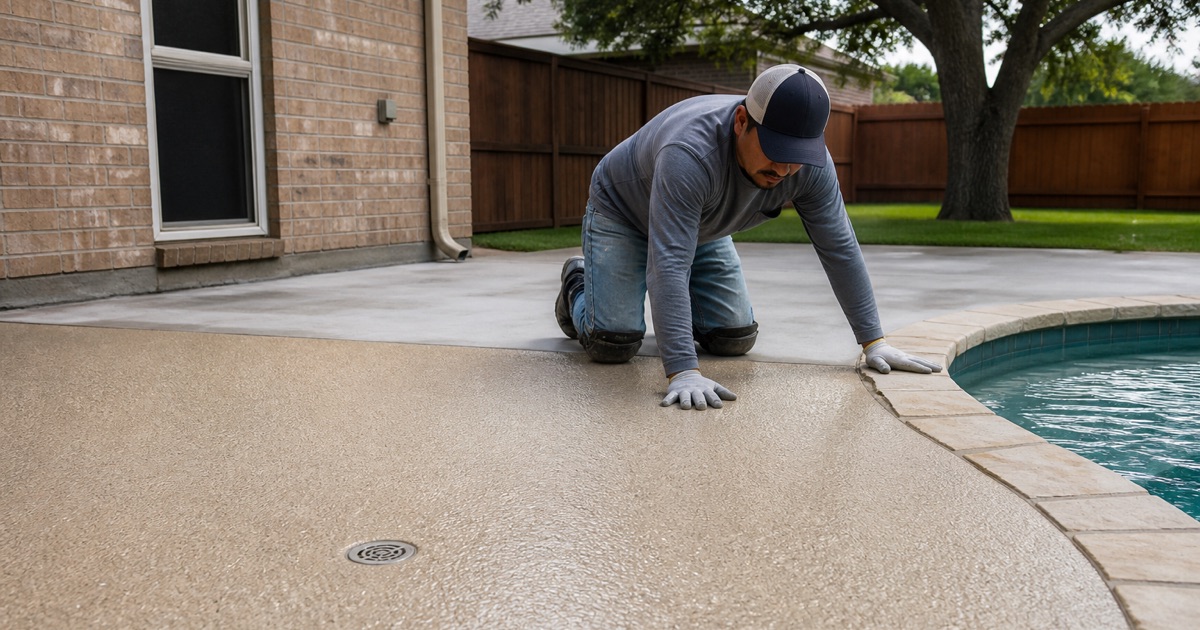
The most common resurfacing route on an existing concrete deck is a polymer-modified cementitious or acrylic overlay, sprayed or troweled over the prepared slab and finished with a knockdown texture. It bonds well, takes integral color, and the texture is built into the material rather than sprinkled onto it, so it does not wear away as a topical additive can. It also stays cooler than a dense, dark resin surface, which matters more here than almost anything else about it.
Polyaspartic and Polyurea Systems With a Broadcast Texture
Where a harder, more chemical-resistant surface is wanted, we build a resin system with a broadcast aggregate for traction and a UV-stable polyaspartic or polyurea topcoat. Epoxy is not ultraviolet stable and ambers in sunlight, so it never goes on top outdoors even where it does the structural work underneath. These systems clean easily and resist pool chemistry well, and they are the right answer around a spa, an outdoor kitchen or a deck that takes furniture.
Repair-Only Work Where the Deck Is Sound
Not every deck needs resurfacing. Where the concrete is structurally fine and the problem is a few spalled patches, a stained area or a joint that has opened up, we will say so and quote the repair rather than the overlay. Matching a repair into an existing weathered deck is honest work with an honest limitation, which is that a patch on an aged surface never disappears entirely, and we would rather you knew that before deciding.
Heat, Traction and Color
Surface Temperature and Why We Keep the Value Light
An exterior slab in full sun runs far hotter than the air around it, and the color of the finish is the single biggest thing you control about that. A dark surface on a deck that is already sun-loaded is uncomfortable to stand on and can be genuinely painful for children. We steer pool deck color toward light and mid values and reserve dark tones for borders, bands and shaded areas, because comfort here is a specification rather than a preference.
Slip Resistance Built Into the System
Around water, traction is a safety requirement and it belongs in the material rather than in a sealer. Knockdown textures create it mechanically, and resin systems get a broadcast aggregate sized so the surface grips a wet bare foot without being abrasive enough to scrape skin. That balance is the whole art of a pool deck finish, and it is set by aggregate size and broadcast rate, which is why we agree those before the job and not on the day.
Color, Pattern and Borders
Overlays take integral color and can be stenciled, stamped, banded or scored into patterns, and a border in a deeper tone around a light field is the usual way to get visual interest without heating the walking area. Cool decking, flagstone patterns and clean modern bands are all achievable in the same material. We put a sample down on your own deck rather than working from a chart, because color reads differently in Texas sun than it does indoors.
What Has to Be True of the Deck First
Cracks, Movement and the Ground Underneath
An exterior slab on reactive clay moves with the season, and a deck that has cracked once will keep moving at that line. We route working cracks and fill them with a flexible filler so they behave as joints, and we carry them through the new surface rather than burying them. Where a deck has settled differentially against the coping or the house we say so plainly, because that is a base or a structural problem and no overlay fixes it.
Drainage, Falls and Where the Water Goes
A deck has to shed water away from the pool and away from the house, and resurfacing must not flatten a fall that is already marginal. We check the existing falls with a level before quoting and re-establish them in the overlay where they are wrong, and we detail the edge at the coping and at any drain so water leaves rather than standing. Ponding on a new deck is a finish problem you will notice every single time it rains.
Preparation, Coping and Edges
The existing surface has to be opened up mechanically, so we grind or shot blast the deck to profile and remove any old sealer, paint or failed coating first. Then the detail work decides how it looks: the coating terminates cleanly at the coping rather than running onto it, wraps the edge where the deck steps down, and stops at a saw line or a control joint rather than at an arbitrary point where a straight edge would be obvious for years.
- 20+ Years in Central Texas
- Insured & Workers Comp Covered
- Free Written Estimates