Pflugerville Epoxy Flooring installs epoxy flooring in Round Rock, and in this city the first question on a quote is usually not what color you want. It is what is already on the slab, how long it has been there and how it is coming off, because a large share of the garages here have carried a coating before.
We have been grinding, testing and coating concrete in this part of Central Texas for more than 20 years, and a meaningful part of that work has been second and third floors rather than first ones. That is a different job from a bare slab, and pricing it as though it were the same is how a coating ends up bonded to a layer that is already failing.
What follows is how we approach a garage with a history, why the age of the slab changes the starting condition rather than the finished product, and how the ownership pattern and the permitting picture in this city shape the way the work gets bought and booked.
The Garage That Already Has a Floor on It
Finding Out What Is Actually Down There
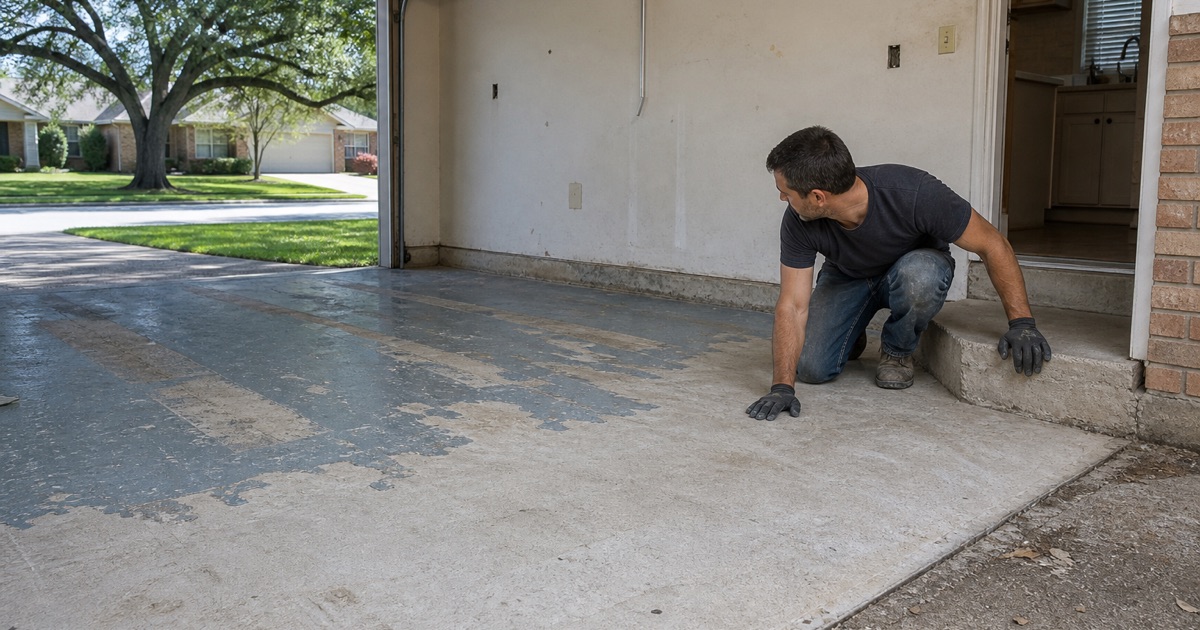
Roughly one housing unit in five in this city was built during the 1970s and 1980s, which is a substantial layer of stock old enough to have been coated once already, and sometimes more than once. What is on those slabs varies enormously: a one-part garage paint from a hardware store, a rolled two-part kit, a properly built system installed by a contractor, or two of those on top of each other.
We identify it before quoting, because each one behaves differently under tooling and each one implies a different amount of labor. A thin paint comes off quickly; a well-bonded high-build epoxy does not, and pretending otherwise on an estimate simply moves the argument to the invoice.
Where the history is genuinely unknown we take a small test area down to concrete before writing a number, so the removal allowance in your proposal is based on what the tooling actually did rather than on an optimistic guess. That half hour is the cheapest part of the whole job.
Grinding It Off, or Bonding to What Is There
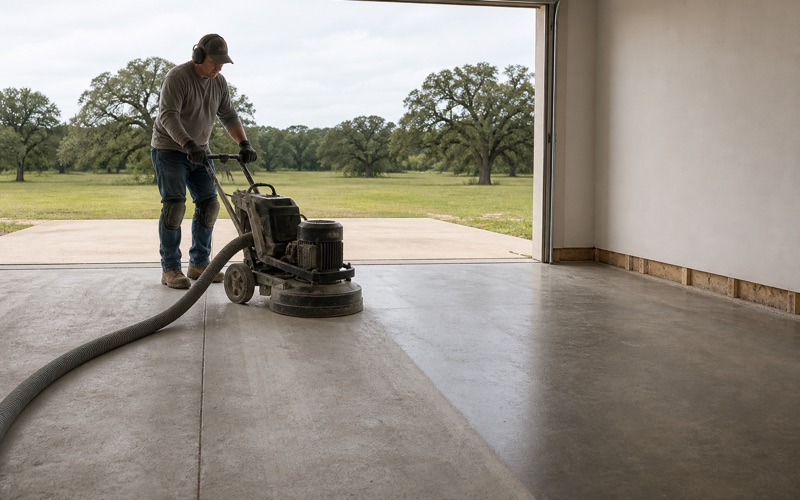
There are only two honest options, and they are not equally available. Where the existing film is genuinely sound, fully bonded and compatible, it can be mechanically abraded and used as a base, which saves real money. Where it is peeling, blistering, sitting on a sealer or of unknown chemistry, it comes off entirely with PCD tooling, diamond grinding and shot blasting.
We test adhesion in a small area rather than deciding from across the room. A new system is only ever as attached as the layer beneath it, so bonding to a film that is quietly letting go buys you the same failure with an extra invoice attached.
Reading Why the First Coating Failed
An old floor that failed is evidence, and we would rather use it than throw it away. A sheet lifting clean with a glassy back face says the slab was never properly opened up. Blisters with a damp ring underneath say moisture. Lifted patches only under the wheels say the film was too thin or was driven on before it cured.
Each of those points to a different thing we have to do differently this time, which is the entire value of looking. Reinstalling over an undiagnosed failure is the most common reason a customer ends up paying for the same floor twice.
It also changes the specification rather than just the preparation. A slab that failed on moisture gets a mitigation primer written in, one that failed on adhesion gets a deeper mechanical profile, and one that failed under tires gets a heavier build and a longer stated cure before the car returns.
Looking for epoxy-flooring closer to Manor? See Manor Epoxy-Flooring.
A 1979 Slab and a 2015 Slab Are Not the Same Starting Condition
The Older Layer Sits Alongside a Much Larger New One
It is worth being accurate about the mix here. The median year built in this city is 2002 and around three quarters of the stock went up in 1990 or later, so the older garages are a significant layer rather than the majority. There is also a small pre-1960 group near the original townsite, which is genuinely rare in this part of the metro.
That means we cannot work from a single assumption about age, and neither should a quote. The difference between the two ends of that range shows up in trowel finish, surface hardness, joint layout and what has been done to the floor since.
What Changes on a Slab With a Service History
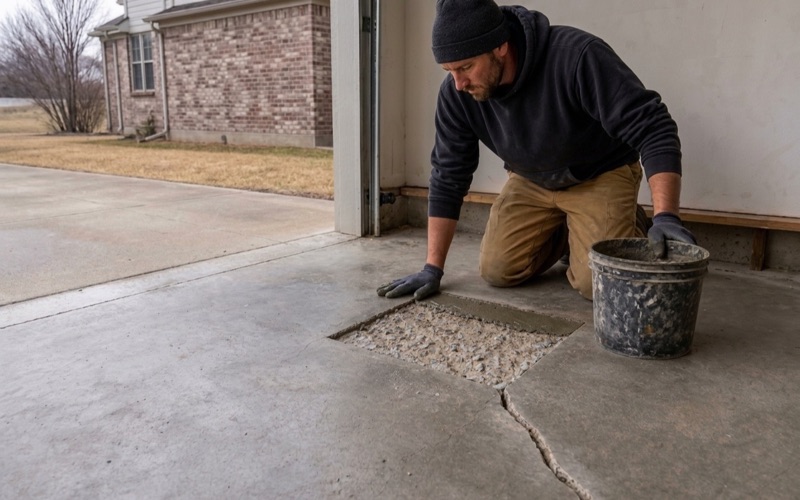
Older garages tend to have been lived with. There are oil stains that have soaked in rather than sitting on top, patched trenches from plumbing work, saw cuts that were added later, and paint overspray from other projects. All of that has to be dealt with as preparation rather than discovered halfway through.
Contaminated concrete is the one that costs time. Oil that has penetrated has to be degreased and then mechanically removed to sound material, because a coating over it will not bond no matter how good the product is.
Older joint layouts add their own work. Control joints cut on a wider spacing than modern practice, and saw cuts added later for a trench, both have to be carried through the finished floor and filled with a flexible semi-rigid polyurea rather than coated solid across.
Testing Rather Than Assuming, Either Way
Age tells you nothing reliable about how much water vapor a slab is passing, so we test rather than infer. Calcium chloride kits and in-situ relative humidity probes give a number that gets read against published thresholds, and where it is high a moisture-mitigation primer goes into the scope as a line item.
That applies to the newer garages just as much as the older ones. We treat moisture as a measurement on every slab rather than as an extra that gets sold after a floor has already blistered.
When the Person Paying Is Not the Person Parking
Detached Houses That Answer to a Landlord
Close to one in five occupied detached houses in this city is a rental, and around forty-five percent of all occupied housing is rented. That changes who buys a garage floor and why: the decision is made on turnover, tenant retention and maintenance cost rather than on how the space looks on a Saturday.
We quote that work differently, with durability, cleanability and a realistic recoat interval given more weight than finish options. Scheduling also has to fit a vacancy window, which is usually short and rarely negotiable.
Multifamily Decks, Breezeways and Capital Reserves
Several thousand units here sit in structures of twenty or more, and their coated surfaces are stair landings, breezeways, trash and laundry rooms and elevated parking decks. Those are traffic-coating problems rather than garage-floor problems, bought by property management against a capital reserve plan.
They also have to be installed in phases, because residents cannot be locked out of the only route to their front door. We plan the phasing and the notice period as part of the proposal rather than treating it as site logistics.
The specification question on those surfaces is usually waterproofing and slip resistance rather than appearance, since an elevated deck is a roof over whatever is parked below it. That moves the product family and it moves the detailing at drains, upstands and expansion joints.
Institutional Floors on Fixed Shutdown Windows
Hospital and higher-education campuses inside the city buy floors on published shutdown windows, and those dates do not move for a contractor. Academic breaks and clinical decant schedules are fixed and long-lead, which is the opposite of a residential garage’s flexible weekend.
There is also precision manufacturing here, and those floors are quoted against a measured surface resistivity range and a published slip specification rather than against a flake blend. We would rather have that conversation early than be handed it at submittal.
Booking Around a City That Keeps Its Own Hours
A Code Cycle Read Off the City, Not the Metro
This city enforces the 2024 International Codes and the 2023 National Electrical Code, which puts it a full cycle ahead of some of its neighbors. For a commercial floor that matters, because a specification written against another city’s fire code edition is not portable across the line.
We read the applicable edition off the jurisdiction rather than off the region. It is a small piece of diligence that avoids a resubmittal, and resubmittals are what actually cost time on commercial work.
One Government for Building and Fire Review
Building review and fire review sit in the same municipal government here, with no separate emergency services district running its own plan review alongside the city’s. That reduces the number of counters a commercial coatings job has to clear, and it is a genuine difference from several communities nearby.
Permits are filed through the city’s own portal, and the Building Inspection Division on West Bagdad Avenue keeps office hours Monday through Friday, 7:00 a.m. to 4:00 p.m. Knowing that before you need an answer is worth more than it sounds.
County Lines, Health Districts and the Edge of the Map
Almost all of the incorporated area sits in Williamson County, but a small slice sits in Travis County, and for a food establishment the health authority follows the county rather than the city. A restaurant on one side of that line is a different permitting path from one a few streets away.
The city’s extraterritorial jurisdiction is the other edge case worth naming. Plat and subdivision review reaches out into unincorporated ground, but city building inspection does not follow it there, so a job on an ETJ parcel is a county job with a city planning overlay rather than a city job.
- 20+ Years in Central Texas
- Insured & Workers Comp Covered
- Free Written Estimates