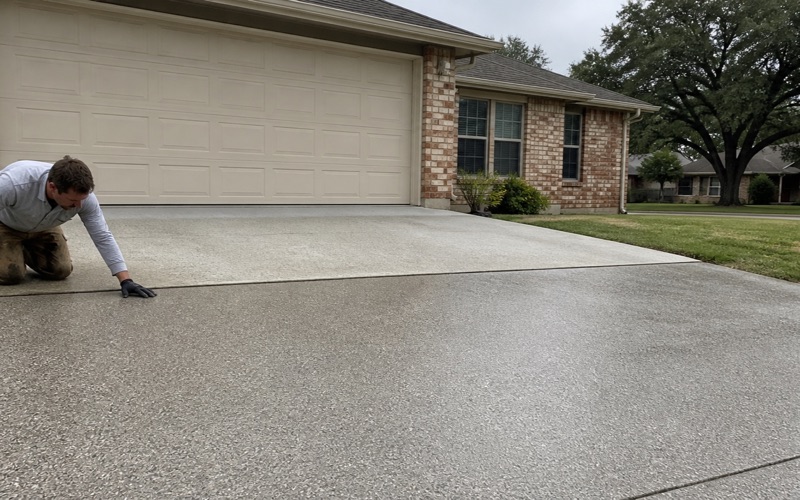
Pflugerville Epoxy Flooring installs epoxy flooring in Santa Rita Ranch, and the honest opening statement about this community is that the ground under it is a per-address question. The soil map changes between one street and the next, and the half of it that is not a Vertisol does not move less at slab depth. It moves more.
We have been coating concrete across Central Texas for more than 20 years, and this is the community where a general soil answer would do the most damage. It sits right on the escarpment line, with roughly 51.7 percent of its area in one major land resource area and 48.3 percent in the other, which is about as close to an even split as a place can be.
So this page does not offer a single substrate answer, because there is not one to give. What it does instead is set out what is actually mapped here, which parts of it move and how much, and what a coating can honestly promise on ground like this.
Why the Map Unit Changes Street by Street
What Is Actually Mapped Here
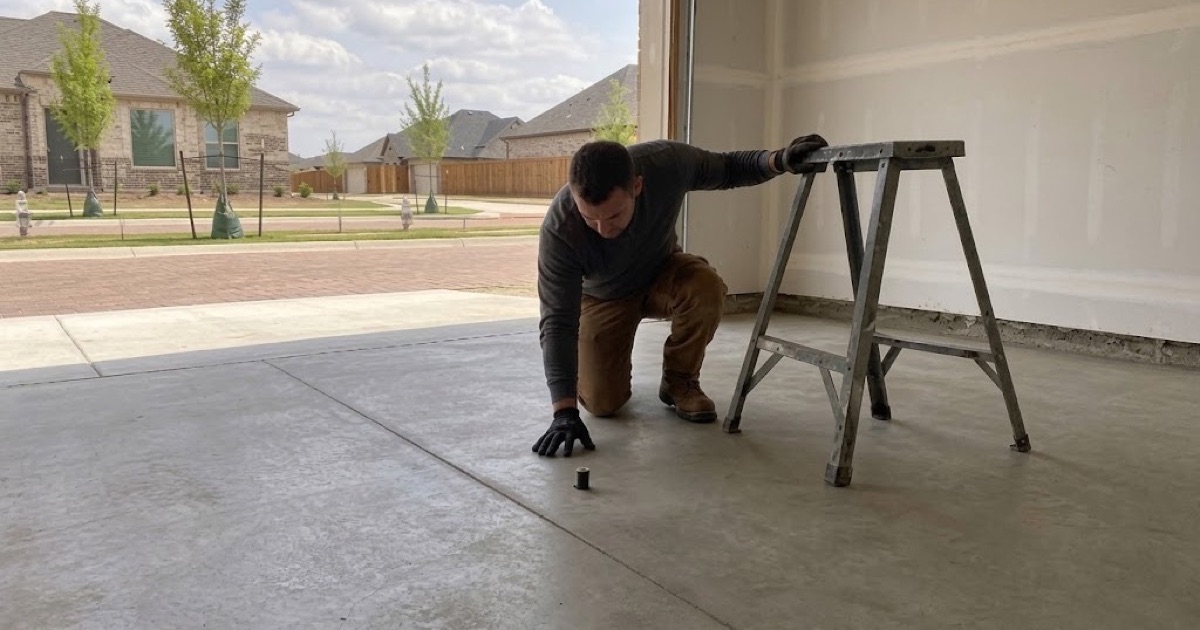
Area-weighted soil mapping across this community gives Fairlie clay about 46.9 percent of the surface, the Georgetown clay loams roughly 28.1 percent together, Eckrant around 11.8 percent, the Brackett and Real complexes about 6.8 percent, and Crawford roughly 2.3 percent.
Fairlie is a Vertisol and Crawford is another, so the Vertisols come to about half the place rather than all of it. That is the first thing to get right, because a page describing this community as uniformly Blackland clay would be describing about half of it and getting the other half wrong.
An Even Split Across an Escarpment Line
This community sits directly on the boundary between two major land resource areas, and the mapped soil changes accordingly over short distances. That is not a subtlety in the data, it is a description of what happens as you drive across the place.
The practical consequence is that we establish which map unit is under your particular address rather than working from a community-level generalization. Two houses on different streets can genuinely need different crack and joint detail.
That is also why we will not quote a floor here from a photograph and a square-foot number. It is not caution for its own sake; it is that the single most consequential input to the specification is not visible in a picture of the garage.
Why That Matters More Than It Sounds
Most soil conversations in this trade are about degree: more reactive or less. Here it is about which material entirely, and the answers are far enough apart that the wrong assumption produces the wrong specification rather than a slightly conservative one.
Crawford clay makes the point. It is the highest-movement soil mapped here, at roughly 10 to 11 percent linear extensibility over rock at 69 to 76 centimeters, and it covers only about 2.3 percent of the area. A small share of the community sits on the most reactive ground in it, and nothing about the street tells you which houses.
The reverse is true as well. A house sitting on one of the shallow rocky units has a genuinely easier slab than its neighbor three streets over, and there is no reason for that owner to pay for detail their ground does not need.
Looking for epoxy-flooring closer to Lago Vista? See Epoxy-Flooring Services in Lago Vista.
The Soil That Is Not a Vertisol Moves More
The Georgetown Subsoil
Here is the reading that inverts the usual intuition. The Georgetown series is a Mollisol rather than a Vertisol, and people reasonably assume that means lower movement. At the surface it looks that way, and at slab depth it does not.
Georgetown’s subsoil from roughly 17 to 89 centimeters carries about 70 percent clay with a plasticity index near 48 and linear extensibility in the range of 7.5 to 8.5 percent. That is the depth a slab actually bears on, and those numbers are higher than a great deal of what gets called expansive clay elsewhere.
So the non-Vertisol majority soil here does not move less than the Vertisol mapped beside it. At the depth that matters, it moves more, which is precisely the kind of thing a surface-level soil description hides.
Where the Low-Movement Ground Actually Is
There is genuinely low-movement ground in this community. Eckrant, Brackett and Real together account for roughly 19 percent of the area, hitting rock at shallow depths with linear extensibility figures far below the clays.
The catch is where it sits. That shallow rocky ground is on the slopes rather than on the flat, and subdivisions are laid out on the flat. So the most stable ground here is largely not the ground the houses are on.
Reading Your Own Slab
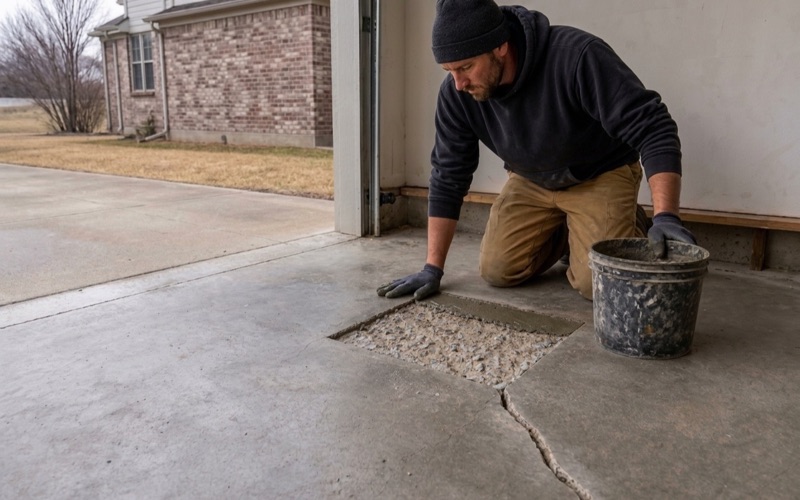
None of this substitutes for looking at the concrete. We read the cracks that are already in your floor, separating a settled crack with worn, closed faces from one that is still opening and closing with the season, because the two get completely different treatment.
Getting that wrong is what puts a line back through a brand new floor. A settled crack can be routed, filled rigid and ground flush and generally stays gone; a working one cannot, whatever is put in it.
On a stock this recent there is a third possibility worth naming, which is a shrinkage crack from the pour itself rather than anything the ground did. Those are common on young slabs, they are usually finished moving, and they are the easiest of the three to deal with permanently.
What a Coating Can Honestly Promise
A Film Follows the Slab
A coating is a film a few thousandths of an inch thick. It follows the slab underneath it, and it cannot bridge, absorb or resist substrate movement. No product on the market changes that, and anyone telling you otherwise about ground with a seven to eight and a half percent linear-extensibility layer at slab depth is selling something that does not exist.
We say that before the job rather than after it. It is the single most important sentence on this page and it is the one a customer is least likely to hear from a contractor competing on optimism.
So a Crack Here Is a Joint
Over ground that moves this much, a crack that is still working is treated as a joint that is still working. We route it out, fill it with a semi-rigid polyurea sized to move, and carry the coating over it knowing it may telegraph through again.
You are told that at the estimate. Filling a live crack with a hard epoxy paste and coating over it does not solve anything; it moves the failure a few months out and makes it look like a defect in the new floor rather than a property of the ground.
Testing Rather Than Arguing
Moisture is the other measurable thing, and on this community’s stock it is the more likely callback. Concrete placed within the last few years may still be releasing moisture, and efflorescence and vapor emission on a young slab are both testable before quoting rather than arguable afterward.
We test with calcium chloride kits or in-situ relative humidity probes and read the results against published thresholds, then price a moisture-mitigation primer into the scope where the numbers call for one. It goes in as a line before you sign, rather than being sold as an extra once a floor has already blistered. That ordering is the whole difference between a known cost and an argument.
Settling the Slab Question Before Anything Is Cut
Post-Tension Is an Expectation, Not a Confirmed Fact
Slab construction here is very probably post-tension given how recent the stock is, and we have not confirmed it for this community, so we treat it as an expectation to check rather than a fact to rely on.
That distinction matters more here than almost anywhere, because cutting or anchoring into a post-tension slab can sever a tendon, and that is a structural repair rather than a flooring problem. We check against the builder’s documentation and the physical evidence before anything is routed, cored or anchored.
What We Do While the Question Is Open
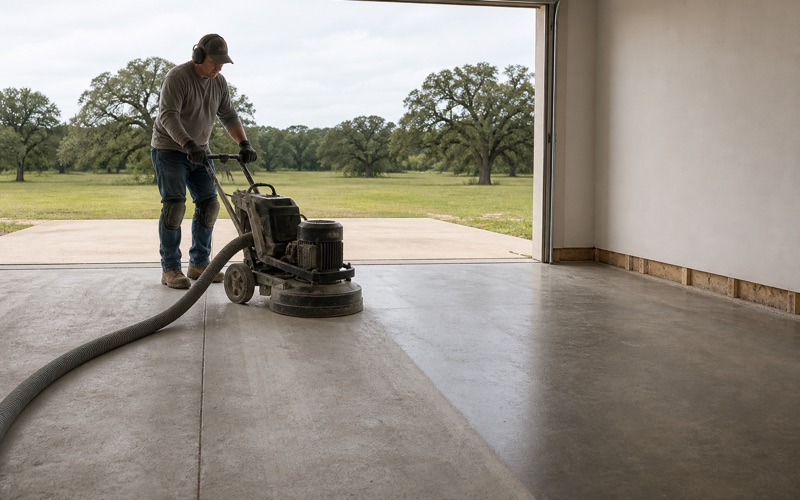
Grinding and shot blasting are surface operations and go nowhere near reinforcement of either kind, so the great majority of a floor coating is unaffected either way. Where a crack needs opening we keep the rout shallow until the layout is established.
Where an operation cannot be moved and the evidence is ambiguous, we scan rather than accept the risk. It is a small amount of time against a consequence that no flooring contractor can put right.
We also write into the proposal what will and will not be cut on a slab we believe to be post-tensioned. That way there is no ambiguity later about why a detail was done a particular way, and there is a record for whoever works on the slab next.
What Is on the Slab, and What Is Not on the Page
The builder finish is the other thing to deal with. A power-troweled surface is dense and closed and frequently still carries a curing compound, so every slab is opened mechanically to a proper profile. We do not acid etch and we never coat over an existing sealer.
One last note on honesty about this place. The community’s statistical boundary is smaller than the development it shares a name with, and the population and unit estimates carry wide margins, so we quote shares rather than counts and we do not mix development-wide figures with place-level ones inside the same sentence.
- 20+ Years in Central Texas
- Insured & Workers Comp Covered
- Free Written Estimates