Pflugerville Epoxy Flooring installs epoxy flooring in Steiner Ranch, and this community has the thinnest soil column of anywhere we work. The survey runs out of dirt before a trench runs out of depth, and the number that governs what can be done here is how far down the rock starts.
We have been coating concrete across Central Texas for more than 20 years, and most of that time is spent thinking about clay that swells and shrinks. Here the governing constraint is the opposite. The ground under this community is shallow and stable rather than deep and reactive, and almost everything that follows on this page comes from that one fact.
That changes what we worry about. It takes seasonal slab movement out of the front of the conversation and puts anchoring, trenching and drainage in its place, and it makes the permitting question worth spelling out because there is no city here to answer it.
How Far Down the Rock Starts
What USDA Actually Rates This Ground For
The United States Department of Agriculture rates 84.75 percent of this community’s mapped area very limited for small commercial buildings. The features it cites are slope, on 99.57 percent of the mapped area, and depth to soft bedrock, on 61.25 percent.
What it does not cite is shrink-swell, anywhere. That is genuinely unusual in this metro, where shrink-swell is the leading limitation across most of the Blackland side, and it is worth saying plainly because the standard Central Texas soil conversation does not apply here.
We use those ratings the way we use any independent record. They come from a source with no stake in selling a floor, and a customer can check them, which makes them a better basis for a conversation than anything we could simply assert.
Brackett Over Limestone
The dominant soil is Brackett, a shallow loamy carbonatic soil covering roughly 54.78 percent of the mapped area, running around 30 percent clay with a plasticity index of 17.3 and a linear extensibility near 2.96 percent. Eckrant covers about 8.34 percent and Real about 6.46 percent.
Those are shallow soils over limestone rather than deep clay profiles. The clay content is moderate, the plasticity is moderate, and the depth is the thing that stands out, because the profile simply stops at rock.
The community sits almost entirely on the Edwards Plateau side of the escarpment, with Vertisols at around 2.5 percent of the mapped area. So a soil argument borrowed from a Blackland city a few miles east is not a small exaggeration here, it is the wrong material entirely.
Why Depth Is the Number That Governs
For a floor coating on an existing slab, none of this changes the resin. What it changes is everything that happens around the floor, because anything that has to go into the ground meets rock sooner than the plans assumed.
That is why we ask about the surrounding work rather than only about the slab. A coating job that includes a new drain, a sump, a threshold alteration or an exterior transition can turn into a rock-excavation question, and it is much better to know that at the estimate.
Looking for epoxy-flooring closer to Serenada? See Epoxy-Flooring in Serenada.
Anchoring, Trenching and Drainage
When the Soil Column Is Shallower Than the Trench
Running a new drain line, setting a post, or trenching for anything outside the garage door here frequently means hitting rock at a shallower depth than the same job would elsewhere. That is a cost and a schedule item rather than an obstacle, and it is one that surprises people who have only worked further east.
We flag it before quoting anything that involves ground works. Where the scope can be adjusted to stay on top of the rock instead of going through it, that is usually the cheaper answer and we will say so.
Drains, Sumps and What Can Be Cut
Inside the building the same logic applies to the slab. Cutting a channel for a trench drain in a garage, coring for a floor drain, or setting mechanical anchors all have to account for how much depth there actually is, and on a slab poured over shallow rock the answer is sometimes less than expected.
Where a drain is being added we detail the coating into it properly, carrying the system down the throat and terminating at a mechanical key rather than feathering to a thin edge. A feathered termination at a drain is the first place a floor starts lifting.
Working Outside the Garage Door
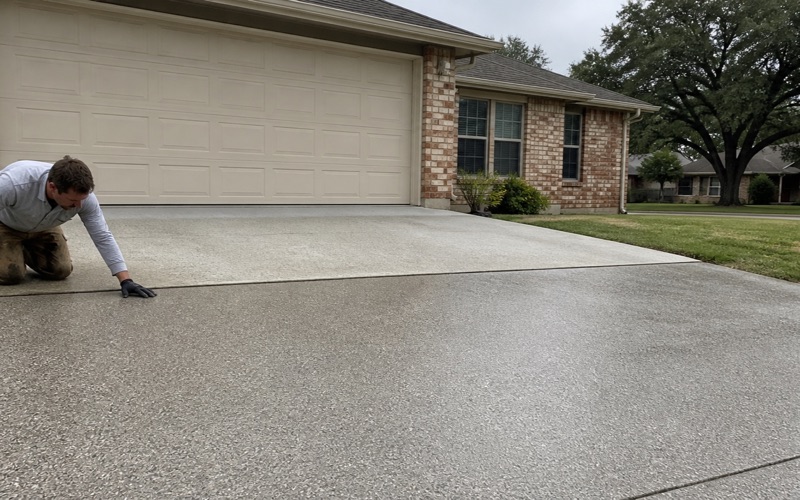
Driveway and apron work is the other place this shows up. Slope is cited on virtually the entire mapped area here, and slope means water moves quickly across a surface rather than sitting on it, which is helpful for a coated exterior surface and unhelpful for anyone trying to establish a fall that already exists.
We check existing falls with a level before quoting exterior work, and we detail the edge so the coating terminates at a saw line or a control joint rather than at an arbitrary point. On sloping ground a straight, deliberate termination is far more visible than it would be on a flat lot, so it is worth placing on purpose.
What a Low Linear Extensibility Means for Your Cracks
Around Three Percent, and What It Implies
Linear extensibility measures how much a soil changes dimension between wet and dry. The dominant soil here sits near 2.96 percent, against readings above 12 percent on the reactive Blackland soils a short drive east.
That is a difference of roughly a factor of four, and it means the seasonal movement that drives crack detail on the eastern side of the metro is a much smaller factor here. It does not mean nothing moves.
Reading a Crack Here
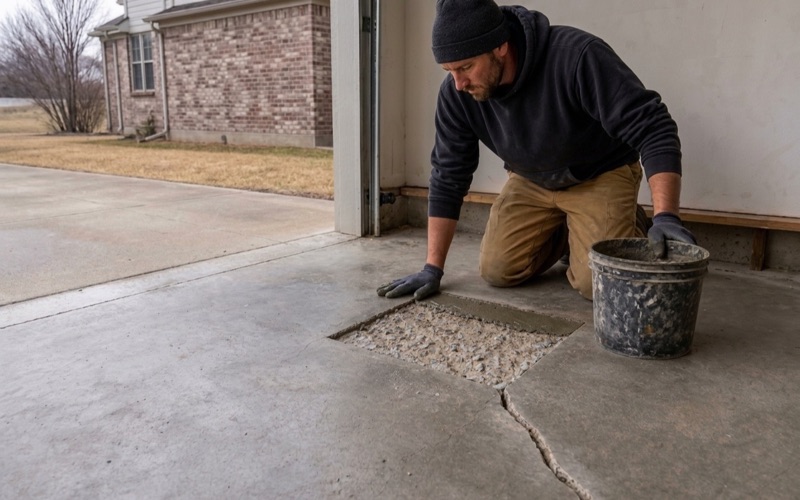
Where ground movement is low, a crack in a slab is more likely to be settled and finished than to be actively working. A settled crack has worn, closed faces and matched offsets, and it can be routed, filled with a rigid epoxy and ground flush with a reasonable expectation that it stays closed.
We still look rather than assume, because drainage, tree roots and a leaking line can all move a slab locally regardless of what the regional soil does. Where we do find an active crack we detail it as a flexible joint with a semi-rigid polyurea and tell you before the job that it can telegraph through again.
A Post-1990 Slab Population
The build-out here is concentrated in the 2000s, with roughly 91.9 percent of the stock built in 1990 or later. That is a modern slab population, so framings that depend on decades-old coating failures or pre-modern construction simply do not describe this community.
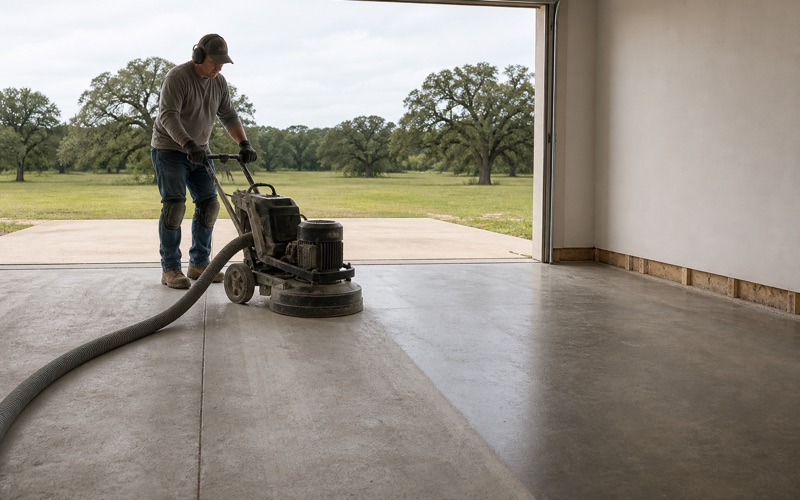
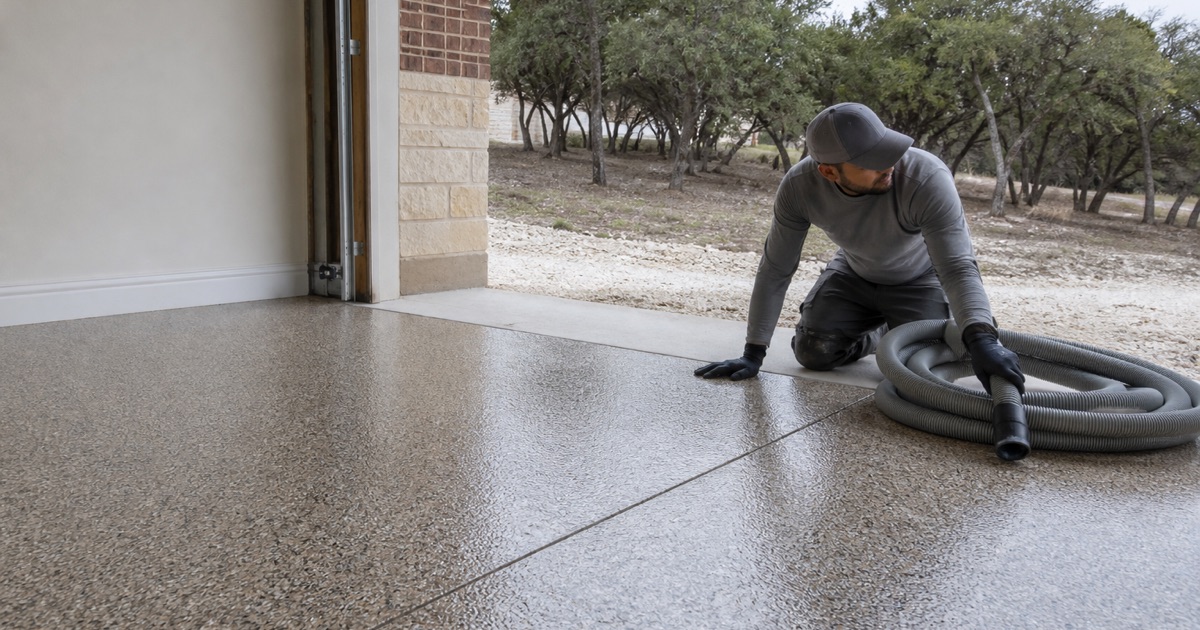
What does apply is what a builder leaves behind. Modern garage slabs are power-troweled to a hard, closed surface and frequently still carry a curing compound, so every slab is opened mechanically with a grinder or a shot blaster. We do not acid etch and we never coat over an existing sealer.
Moisture testing still goes into the scope as a priced line item. The vapor-retarder requirement carries a garage exemption that does not depend on build date, so a newer garage is not automatically a dry one and the only way to know is to measure.
Water, Wastewater and Who Permits
One District for Both Services
Travis County Water Control and Improvement District No. 17 holds both the water certificate and the sewer certificate at this location and draws surface water from Lake Travis. One district answers both questions, which is simpler than the split arrangements in several nearby communities.
The internal point of this community falls in no mapped Edwards Aquifer zone, so the state’s Edwards rules are not the governing water-quality instrument here. That is worth knowing because it is easy to assume otherwise from the general area.
Where Wash Water Goes
None of that removes the obligation to handle our own waste properly. Grinding is done with vacuum-shrouded equipment and HEPA-rated extraction so the byproduct is a bagged dust rather than a slurry, and any wash water or solvent rinse is contained and taken off site.
We apply the same standard everywhere rather than adjusting it by location, because a crew that changes its habits by address will eventually get the address wrong. It is also simpler to run one method than two. Containment gear that lives on the truck gets used, while containment gear that has to be decided on each morning frequently does not.
No City Permit, and Why the Mail Misleads
Steiner Ranch lies inside no city limit. There is no city permit and no city inspector, and the City of Austin issues nothing here despite an Austin mailing address and the community’s position inside Austin’s two-mile extraterritorial jurisdiction. An extraterritorial address is not a city-permit address.
The permitting authority is Travis County Transportation and Natural Resources, whose permits are development-based, and the state’s residential building-code provisions for counties reach only new houses built on vacant lots rather than work on an existing home. Even where they do apply, inspections are contracted to a private licensed inspector rather than performed by a county department.
For a garage floor coating that generally means there is nothing to apply for, and it is not a reason to lower the standard. As everywhere in Texas there is no flooring or coatings license to hold either, so what we produce is general liability cover, workers compensation and a sales and use tax permit, sent before the job rather than on request.
- 20+ Years in Central Texas
- Insured & Workers Comp Covered
- Free Written Estimates