Pflugerville Epoxy Flooring installs epoxy flooring in Taylor, and this is the city on our list where the age of the floor is the first question rather than the last. Roughly half the housing here was finished before 1980, and the commercial core is a National Register district of single-story blocks sitting directly on grade.
More than 20 years of coating concrete in Central Texas means we have worked on slabs from most of the eras represented here, and they are genuinely different starting conditions. A floor poured in the 1920s behind a downtown storefront and a floor poured last year in a new subdivision share a material and almost nothing else.
This page is about how we approach that. It covers the commercial floors downtown and the review step that reaches them, what a genuinely old residential slab brings with it, and what the city’s own engineering documents already say about the ground before anyone opens a product catalog.
One-Part Commercial Blocks Downtown
The Commonest Downtown Floor in This City
The Taylor Downtown Historic District was listed in the National Register of Historic Places on October 26, 2005 under reference number 05001193. It holds 122 properties, of which 84 are contributing, and spans approximately 16 full city blocks plus portions of six others, with its earliest contributing building dating to 1878.
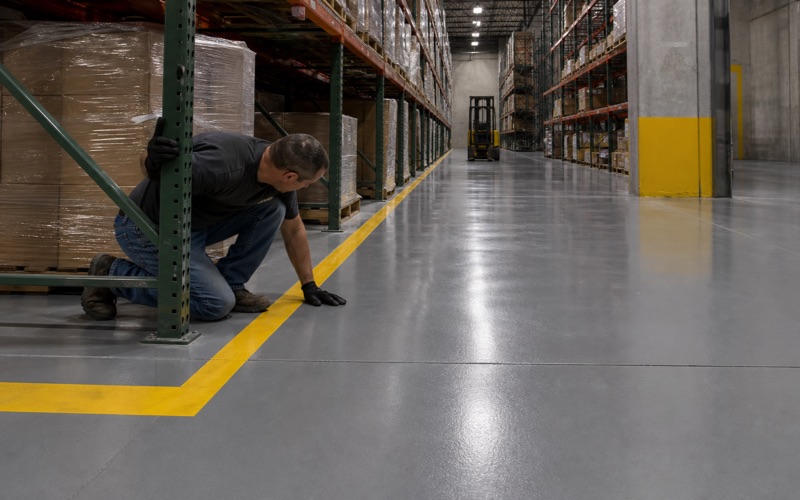
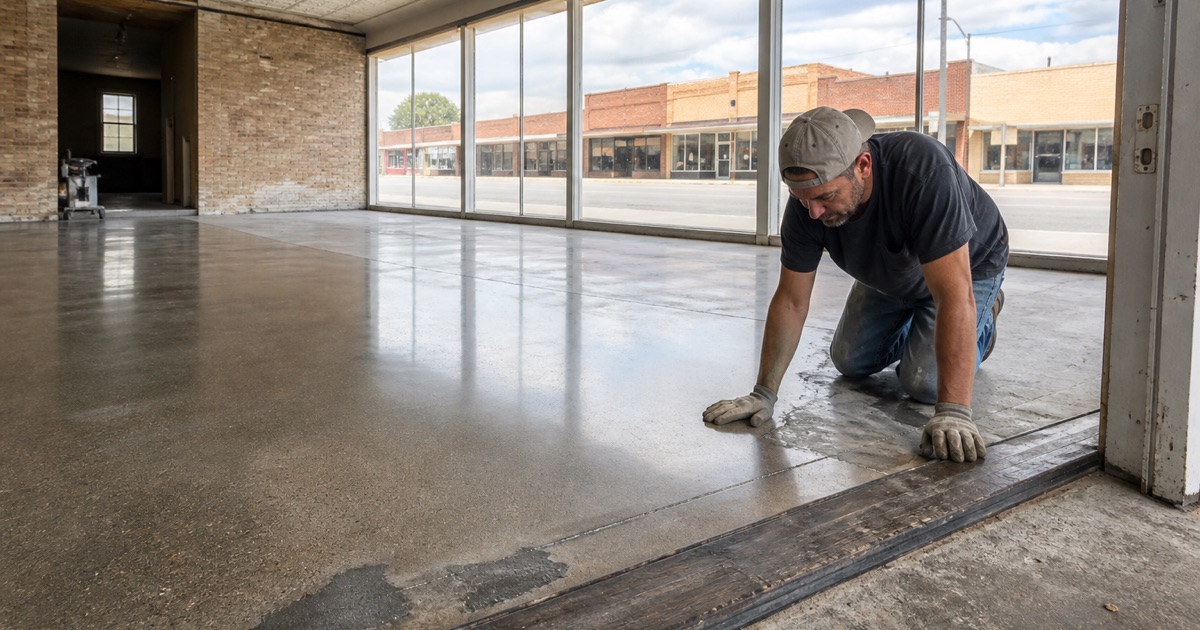
A large share of that stock is one-part commercial block construction: single-story, street-fronting, with the retail floor sitting directly on grade. That is the commonest commercial floor in this city by a wide margin, and it is the building type most of our downtown work happens inside.
A Retail Floor Sitting Directly on Grade
A slab on grade in a building of that age was poured under conventions that no longer apply, and there is no reason to expect a vapor retarder beneath it. Thickness can vary across a single room, reinforcement may be absent, and the surface has usually been covered, uncovered and patched several times across a century of tenants.
None of that rules out a coated floor, and we install them in these buildings regularly. It does mean the assessment is longer than it would be on a suburban slab, because the useful information is not in the year the building went up, it is in what the concrete is doing now.
What We Do Before Quoting a Downtown Floor
We sound the slab for delamination, look at what has been glued or mortared to it over the years, and test moisture on bare concrete rather than assuming. Old floors are frequently carrying mastic, thinset, layers of tile adhesive or a poured topping somebody added in the 1960s, and all of it has to come off with the appropriate tooling before anything new bonds.
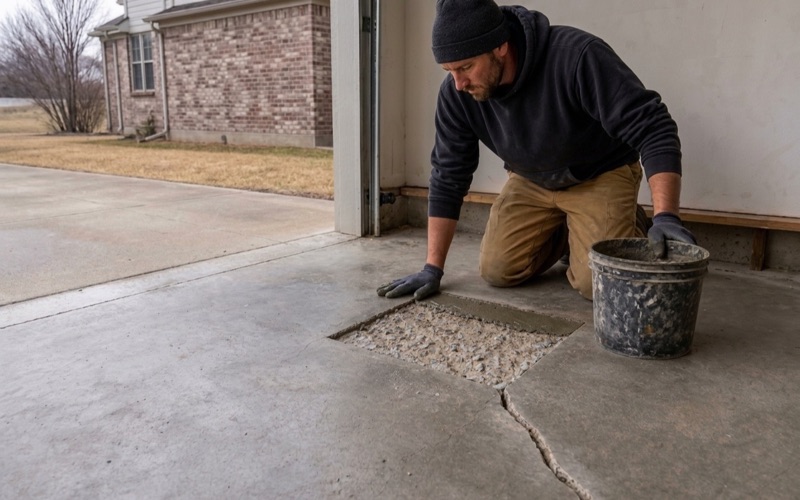
Where the surface itself has gone we resurface before coating rather than putting a film onto weak material. Coating a spalled or delaminated surface only bonds the new floor to the part that is already leaving.
Looking for epoxy-flooring closer to Cedar Park? See Epoxy-Flooring in Cedar Park.
The Certificate That Comes Before the Permit
Approval Before a Building Permit Can Issue
Under the city’s Land Development Code, a Certificate of Appropriateness must be approved before the building official may issue a building permit on a property with historic overlay zoning. That is a sequencing rule rather than a formality, and on a project where it applies it sits in front of the permit rather than alongside it.
It is worth being precise about scope, because it is narrower than people assume. The certificate reaches only the portions of a building or site visible from an adjacent public right-of-way, street or alley, and ordinary maintenance is treated differently from alteration.
What It Reaches, and What It Does Not
For a floor coating that distinction usually works in your favor. An interior retail or kitchen floor is not visible from the street, and interior work of that kind is generally outside what the certificate is aimed at. Work that changes a visible surface, such as a sidewalk-level entry or an exterior stair landing, is a different matter.
The other thing worth knowing is that the National Register listing and local overlay zoning are two separate mechanisms. A National Register district is a federal designation; the certificate requirement attaches to local overlay zoning, and which properties carry that zoning is a question to put to the city rather than to infer from the district boundary.
A Commission That Meets Once a Month
The Historic Preservation Commission has five members and meets monthly, on the first Wednesday at 6:00 p.m., reviewing applications against the Secretary of the Interior’s Standards for Rehabilitation. A certificate, once issued, expires one year from issue and may be extended by the commission.
A monthly meeting cycle is the scheduling fact that matters. Missing a submission means waiting a month rather than a few days, which is a real consideration on a tenant fit-out with a lease date attached to it.
Half the Housing Here Predates 1980
The Actual Numbers
Of 7,016 housing units in this city, 3,624 predate 1980, which is 51.7 percent, and 1,142 units were built in 1939 or earlier, which is 16.3 percent. Those proportions are unusual in this part of the metro, where new construction dominates almost everywhere else we work.
We use those numbers as a prompt to look rather than as a conclusion. Half the stock being older does not mean any particular garage is, and the point of quoting them is that an assumption built on newer suburban stock will be wrong here more often than it is right.
What a Genuinely Old Slab Brings With It
A residential slab from before the war, or from the decades just after it, was built to different expectations. Surface hardness can vary considerably across one floor, control joints may be absent or arranged unfamiliarly, and there may be an added topping or a repair from a plumbing trench that nobody remembers.
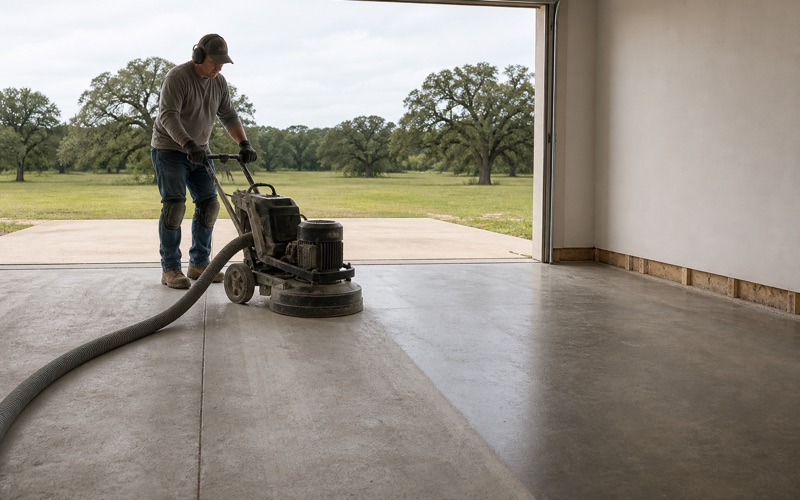
Diamond segment bond hardness has to be matched to the concrete rather than to a default, and on a floor with soft and hard areas that can mean changing tooling partway across a room. It is slower work, and pricing it as though it were a modern production slab is how a job goes wrong for everybody.
Testing Instead of Assuming
Moisture testing goes into the scope as a line item on every slab regardless of age. We use calcium chloride kits, in-situ relative humidity probes or a plastic sheet screen and read the results against the published thresholds, then price a moisture-mitigation primer where the numbers call for one.
Cracks get the same treatment. A settled crack with worn, closed faces is routed, filled rigid and ground flush, while one that is still moving is detailed as a flexible joint with a semi-rigid polyurea and disclosed before the job as something that can telegraph through again.
What the City’s Own Documents Already Say
Three Plasticity Tiers, Written Into the Engineering Manual
The City of Taylor Engineering Manual requires a geotechnical report to accompany all construction plans, and it sets subgrade density and moisture control in three tiers by plasticity index: below 15, from 15 to 35, and above 35. A city that writes a separate tier for ground above a plasticity index of 35 is telling you something without needing an adjective.
We find that useful because it is documentary rather than argumentative. The city’s own requirements are a public record that a customer can check, which is a better basis for a conversation about crack detail than anything we could assert on our own behalf.
Lime Treatment, Sulfates and Proof-Rolling
Where lime treatment is used the manual requires a minimum eight-inch lime-treated subgrade and caps post-treatment plasticity index at 20 for a lime conditioning mix. It also sets soluble-sulfate thresholds, treating subgrade below 3,000 ppm as compatible with lime treatment, 3,000 to 8,000 ppm as generally compatible but requiring city approval, and above 8,000 ppm as incompatible.
Proof-rolling of subgrade is required, with any unstable or spongy material re-worked, dried and compacted or removed and replaced. None of that governs a floor coating directly, and all of it is relevant context on a new commercial slab we are asked to coat.
Where the Code Is Quiet
It is worth noting what the Land Development Code does not say. A full-text search of the adopted code returns nothing on expansive soil, on the Blackland Prairie or on any named soil series. The city’s soil-specific requirements live in the Engineering Manual instead, which is where anyone looking for them should go.
For permits, the city adopted the 2018 International Codes and the 2020 National Electrical Code by ordinance in October 2021 and handles applications through an online portal, with building inspections outsourced. And as always in Texas, there is no flooring, coatings or painting license to hold, so what we show is insurance and a sales and use tax permit instead of a number that does not exist.
A Market That Changed Shape
One last piece of context worth having. Building permits issued in this city went from 274 in fiscal 2022 to 1,179 in fiscal 2023, with 966 in 2024 and 1,208 in 2025. That is a change of shape rather than degree.
Anyone sizing this market from a pre-2022 impression of the city will get it wrong, and that includes contractors deciding whether it is worth driving to. We work here regularly, and the volume is the reason.
- 20+ Years in Central Texas
- Insured & Workers Comp Covered
- Free Written Estimates